Get the old stories right

Walter Kirn@walterkirn Old news is more important than new news because new news is built on top of it. When you are renovating a structure you don't start with the roof but with the foundation. Let's go back and get the old stories right. Otherwise nothing will be right, from here on out.

Thursday, August 10, 2023

Brant Gardner on Book of Mormon geography

In the interest of clarity, charity and understanding, we'll discuss Brant Gardner's interview on the YouTube channel "Mormonism with the Murph," found here:

https://www.youtube.com/watch?v=4DvvRyYXgq0&t=3133s


First, kudos to Murph for his thoughtful, informed questions. His channel is gaining an audience because of his preparation and pleasant, inquisitive and intelligent demeanor.

Second, kudos to Brant for appearing on social media to discuss these issues that he has written and spoken about for many years. 

This episode focuses on Brant's excellent book, The Gift and Power: Translating the Book of Mormon, which was published in 2011.

Brant is a staunch defender of both SITH and M2C. He's articulate and thoughtful, and he's a nice guy. This interview, like his books, might be persuasive to those who accept his assumption, inferences, and biases, and we give him the benefit of the doubt whenever possible. 

When we're all looking at the same evidence (and all the evidence), it is not the facts that lead to different outcomes, but instead our assumptions, inferences, theories and biases. 

The pursuit of clarity requires examination of those assumptions, inferences, theories and biases, especially when they are not made explicit. Clarity, combined with charity, leads to understanding one another with "no more contention." [see www.nomorecontention.com]

But sometimes we have to step back and make sure we're all looking at the same evidence--and all the evidence. 

As a thoughtful scholar, Brant emphasizes the need for accuracy and thoroughness. But in this post, Brant inexplicably misstates underlying facts and makes claims and accusations that don't hold up. Whether consideration of accurate facts would impact his assumptions, inferences, and theories remains to be seen. Because Brant is a good guy and an honest scholar, surely he will correct these errors, explain why he made them, and adjust his positions accordingly. 

Third, kudos for everyone involved with these discussions because when we get into specifics we can  finally reach more clarity, charity and understanding; i.e., no more contention.

Fourth, I'm fine with people believing whatever they want. People can choose whom and what to believe. (Article of Faith 11)

Ideally, everyone would seek to make informed decisions based on all the evidence, fully aware of the assumptions, inferences, and theories that lead to the hypotheses that form their worldview (the FAITH model). With those elements laid out (clarity), we would all have empathy (charity) for one another. Instead of contention, we'd have understanding and no compulsion to try to convince others.

But we're not there yet, neither in the world as a whole nor as Latter-day Saints. It seems that few people seek clarity, charity and understanding. Instead, to the extent they think about issues at all, they accept evidence that confirms their biases and reject evidence that contradicts their biases. People do that all the time. That's how people cope with cognitive dissonance. And that leads to contention, not understanding.

But we can overcome that through clarity, charity and understanding.

What I'm not fine with is scholars purporting to base their views on facts and then deliberately misstating the facts, omitting facts that contradict their theories, and otherwise using sophistry instead of clarity. Readers can decide for themselves how this applies to Brant's interview.

We've previously discussed Brant's approach to so-called "Heartlanders," here:

https://www.bookofmormoncentralamerica.com/2022/04/m2c-citation-cartel-hanna-seriac-and.html

_____

The podcast is 2.5 hours long. In this post, we'll discuss a few of the key points Brant made about the geography issue. We'll use the transcript from youtube with time code for those interested in referring to the youtube interview.

Tomorrow we'll discuss what Brant said about the translation issue.

YouTube transcript

Comments

3:19 Murph: in the last episode there's one um sort of pushback that I forgot to ask you about that people would raise against the mesoAmerican geographical model so we'll talk about that briefly.

Zelph the white Lamanite which I believe comes when Joseph Smith and some of the church leaders are sort of marching in Zion's camp and he points…

I think he writes in a letter how they cross like the plains of the Nephites to his wife Emma

Joseph’s letter to Emma in the Joseph Smith Papers (JSP), describing his activities while traveling west across Ohio, Indiana and Illinois:

https://www.josephsmithpapers.org/paper-summary/letter-to-emma-smith-4-june-1834/2

The whole of our journey, in the midst of so large a company of social honest men and sincere men, wandering over the plains of the Nephites, recounting occasionaly the history of the Book of Mormon, roving over the mounds of that once beloved people of the Lord, picking up their skulls & their bones, as a proof of its divine authenticity,14 and gazing upon a country the fertility, the splendour and the goodness so indescribable, all serves to pass away time unnoticed,

and then there's some

3:46

sources or accounts of there being like a skeleton and he says that's Zelph the white Lamanite. I know heartlanders would use that to support oh The Book of Mormon happened here in North America.

What's your take on that on Zelph the white Lamanite?


Note 14 above in the JSP:

On 3 June, the Camp of Israel passed through the vicinity of what is now Valley City, Illinois, where several members of the camp climbed a large mound. At the top, they uncovered the skeletal remains of an individual JS reportedly identified as Zelph, a “white Lamanite.” Archeologists have since identified the mound as Naples–Russell Mound #8 and have classified it as a Hopewell burial mound of the Middle Woodland period of the North American pre-Columbian era (roughly 50 BC to AD 250). (Godfrey, “The Zelph Story,” 31, 34; Farnsworth, “Lamanitish Arrows,” 25–48.)

4:00

Brant: I think first of all it's important to note that it's a lamanite and not a nephite

Brant is correct that Zelph was identified as a Lamanite. However, the identification was in the context of the larger identification of the Nephites and the great last battle. E.g., Wilford Woodruff recorded this in his journal:

Zelph was a large thick set man and a man of God he was a warrior under the great prophet ^Onandagus^ that was known from the hill Camorah ^or east sea^ to the Rocky mountains. The above knowledge Joseph receieved in a vision.

https://wilfordwoodruffpapers.org/documents/b048a7c5-6b6b-438a-bce7-262d5ba297d8/page/b7e83f61-fb13-43c4-bee7-5ab95fb957f1

the second thing is they talk about going over the planes of uh you know what is it the plains of the lamanites they're plains anyway I think if I remember right but I yeah

4:19

but they're not mentioned in the Book of Mormon so this is not a book of Mormon geographic location uh this is some

4:26

location somewhere but it isn't mentioned in the Book of Mormon

Comment: Brant says JS referred to the “plains of the Lamanites.” Murph doesn’t correct him, but we can all read the account above, where Joseph writes “plains of the Nephites.” 

Maybe Brant simply misspoke, but in the context of his interview, this seems like deliberate misinformation to persuade unsuspecting viewers. 

Brant says the plains are “not mentioned” in the text. While the generalized phrase “plains of the Nephites” is not specifically used in the current text (we can’t know what the 116 pages said), we have several references to Nephite "plains" that were significant in the war chapters and during the destruction before Christ’s visit. In one passage, a specific "plains" is identified "the plains of Nephihah," but in other passages the term is generalized, just as Joseph used the term to describe Ohio, Indiana, and Illinois. 

There were also Jaredite plains, supporting the idea that the Jaredites lived in the same area as the Nephites.

Nephite plains:

I saw the plains of the earth, that they were broken up;(1 Nephi 12:4)

20 And it came to pass they sent embassies to the army of the Lamanites, which protected the city of Mulek, to their leader, whose name was Jacob, desiring him that he would come out with his armies to meet them upon the plains between the two cities. But behold, Jacob, who was a Zoramite, would not come out with his army to meet them upon the plains(Alma 52:20)

And it came to pass that when they had come to the city of Nephihah, they did pitch their tents in the plains of Nephihah, which is near the city of Nephihah.

 19 Now Moroni was desirous that the Lamanites should come out to battle against them, upon the plains(Alma 62:18–19)

Jaredite plains:

28 And it came to pass that Shared fought against him for the space of three days. And it came to pass that Coriantumr beat him, and did pursue him until he came to the plains of Heshlon.

 29 And it came to pass that Shared gave him battle again upon the plains; and behold, he did beat Coriantumr, and drove him back again to the valley of Gilgal. (Ether 13:28–29)

15 And it came to pass that Lib did pursue him until he came to the plains of Agosh. And Coriantumr had taken all the people with him as he fled before Lib in that quarter of the land whither he fled.

 16 And when he had come to the plains of Agosh he gave battle unto Lib, (Ether 14:15–16)

Brant should explain why he misrepresented the scriptures this way.

4:33

we know that uh you know some of the peoples came North there is no reason to believe that we don't have lamanites moving North after the end of The Book of Mormon

M: so it's like uh here you go the lamanite

B: yep

4:47

yeah I mean having lamanites that are northward is not unusual,

Comment: Brant’s point that Lamanites may have moved north is a red herring. Everyone agrees that the Lamanites likely migrated in all directions after the end of the Book of Mormon.

Brant simply doesn't address the point that Joseph specifically identified Nephites while crossing Ohio, Indiana and Illinois. They were roving over their mounds and picking up their bones “as proof of the divine authenticity” of the Book of Mormon.

Nor does Brant mention that Joseph also identified Jaredites in this area.

so you know having him there uh the only thing you have to worry about is this

4:59

idea of being a white lamanite and what does that mean and the definition that you would get from The Book of Mormon would have been that he was a converted lamanite

When he says "the only thing you have to worry about" he's referring to the M2C advocates. Proponents of the North American setting (Heartland) don't worry about anything regarding the Zelph account.

Brant’s idea is congruent with what Wilford Woodruff recorded:

His name was Zelph he was a white lamanite, a large thick set man, and a man of God. The curse had been taken from him because of his righteousness.

https://wilfordwoodruffpapers.org/documents/7fa48660-76da-4b7d-be34-ec03b88b3d57/page/59f7b665-644c-418f-9338-1a1e8a67bacd

and that must mean that somewhere as Mormon or Moroni is doing these travels he managed to talk to some

people and you know convert a few people perhaps some who uh you know kept that tradition going

Brant’s speculation here ignores the historical accounts and merely confirms his M2C bias and worldview.

Instead of engaging in such raw speculation, we ought to look at the actual historical accounts.

For some events in Church history, Wilford Woodruff is the sole source (much like Lucy Mack Smith for JS’s early years). In the case of Zelph, there are multiple accounts from different people who were present. Naturally, each recorded different elements of the event. A good overview is here:

https://www.mobom.org/zelph-account

Woodruff’s account is the most detailed, so I’ll include it here.

From his journal, May 1834:

we visited many of the mounds which were flung up by the ancient inhabitants of this Continent probably by the Nephites & Lamanites[.]

we visited one of these Mounds and several of the brethren dug into it and took from it the bones of a man[.] Brother Joseph had a vission respecting the person he said he was a white Lamanite the curs was taken from him or at least in part[.] he was killed in battle with an arrow the arrow was found among his ribs, one of his thigh bones was broken this was done by a stone flung from a sling in battle years before his death his name was Zelph some of his bones were brought into the camp and the thigh bone which was broken was put into my waggon and I carried it to Missouri.

Zelph was a large thick set man and a man of God he was a warrior under the great prophet ^Onandagus^ that was known from the hill Camorah ^or east sea^ to the Rocky mountains. The above knowledge Joseph receieved in a vision.

https://wilfordwoodruffpapers.org/documents/b048a7c5-6b6b-438a-bce7-262d5ba297d8/page/b7e83f61-fb13-43c4-bee7-5ab95fb957f1

From the History of Zion’s Camp:

On the tops of the mounds were stones which personated the apperance of three altars, one above the other, according to the ancient order, and the remains of bones were shown over the surface of the ground.

Wilford Woodruff says, "this mound was considered three hundred feet above the Illinois river, we had a shovel and a hoe with us, and while we were desending the mound, the Prophet Joseph stopped suddenly and pointed to the ground and said. "Brotherin dig in there."

And when we had dug one foot we uncovered the skeleton of a man, which was entire, and in a good state of perservation, and between his ribs in the back bone was found the stone point of a lamanitish arrow, whiched produced his death. Milton Homes took the arrow out of the back bone, also one of the thigh bones which had been broken, and took it to camp, and put it into my wagon; and at noon while resting in camp, the Prophet Joseph, while lying in his wagon, was rap[p]ed in vision, and the history of this man whoes body we discovered, was shown unto him.

His name was Zelph he was a white lamanite, a large thick set man, and a man of God. The curse had been taken from him because of his righteousness. He was a warrior, and a chiefton He fought under the prophet Onondagus, who held domion from the east to the west sea including the Rocky-mountains. Zelph had his thigh bone broken from the sling of a stone, while in battle, many years before his death. He was killed in battle by the arrow found in his back bone, dureing a great struggle with the Lamenites, and I Wilford Woodruff, carried the thigh bone to Clay County and burried it in that country, I intended to have burried it in Jackson County, thinking that some prophet might have prophisied to him that the members of Zions camp whould have taken his bones with them to Zion and buried them their, when they went up to redeem Zion; But not having the privlage of gowing to Jackson County, I buried it in Clay County.

https://wilfordwoodruffpapers.org/documents/7fa48660-76da-4b7d-be34-ec03b88b3d57/page/59f7b665-644c-418f-9338-1a1e8a67bacd

so we don't know how long after the Book of Mormon closed

5:30

that that would have been there um if we actually had that skeleton and we dug it up archaeologically we'd found that it... we would find that it came from time period long after the Book of Mormon

The note in the JS Papers quoted above explains otherwise:

Archeologists have since identified the mound as Naples–Russell Mound #8 and have classified it as a Hopewell burial mound of the Middle Woodland period of the North American pre-Columbian era (roughly 50 BC to AD 250).

In other words, archaeologists date the mound to Book of Mormon time frames. They have also sourced the artifacts in the mound to the Rocky Mountains and upper eastern Midwest, corroborating what Wilford Woodruff recorded.

Brant the anthropologist surely knows this, but he misled his viewers here. 

M: okay so you wouldn't see that as necessarily undermining the Mesoamerican geographical model and do you also think that this was Joseph Smith maybe guessing because you know you don't believe, we don't believe that he knew uh where the Book of Mormon took place

B: yeah, we don’t

M: do you think he was sorted guessing or speculating

Brant claims that “we don’t" believe Joseph knew where the Book of Mormon took place. He's speaking on behalf of M2C proponents, of course.

I’ve discussed this before:

The entire premise for M2C is that the scholars know what Joseph Smith was secretly thinking, and that among Joseph's thoughts was ignorance about the Book of Mormon and its setting (despite what Joseph actually said). This is how they deal with the extreme cognitive dissonance they experience when they confront Joseph's actions and statements.

Here is an example. In 2005, BYU and the Library of Congress sponsored a two-day academic conference to commemorate the 200th anniversary of Joseph Smith's birth. I blogged about it 
here. The conference proceedings included these statements about what Joseph was thinking in his inner thoughts:

- Joseph Smith did not fully understand the Book of Mormon.
- One thing all readers share with Joseph is a partial understanding of the book’s complexities.
- Over the last sixty years, Hugh Nibley, John Sorenson, and other scholars have shown the Book of Mormon to be “truer” than Joseph Smith or any of his contemporaries could know.
- Consequently,  what  Joseph  Smith  knew  and  understood about the book ought to be research questions rather than presumptions.  Thanks  in  large  part  to  his  critics,  it  is  becoming  clear that Joseph Smith did not fully understand the geography, scope, historical scale, literary form, or cultural content of the book.
- In 1842, after reading about ancient cities in Central America, Joseph speculated that Book of Mormon lands were located there.
- Joseph did not know exactly where Book of Mormon lands were... he considered their location  an  important  question  addressable  through scholarship.

that incident for some people has taken as you know Revelation and some

6:12

people is just a discussion or speculation you know however you want to read that um I would say that most of the scholars would not accept it as a revelation


"For some people" means those who were present at the time and those who accept what they said.

The M2C scholars don’t accept it as a revelation, but Brant offers no rationale for rejecting what Woodruff and others recorded except that Zelph contradicts their theories.

As we saw above, Wilford Woodruff explained Joseph had a vision:

The published history of Zion's Camp gives an account of the bones of a man which we dug out of a mound. His name was Zelph. The Lord showed the Prophet the history of the man in a vision.

https://wilfordwoodruffpapers.org/documents/093b0c5c-db84-40fa-96ea-b4185b18bf43/page/d4ceb072-2ecb-4e2f-a284-6b2d53344fcb

6:25

even in the Heartland for the people who would say yes this was a revelation it would be a revelation that's so late that it wouldn't have anything to do with the Book of Mormon or a book of Mormon geography it would simply say you know this is you know something that occurred after the Book of Mormon ended

Brant repeats his misstatement about the dating of Zelph’s mound and the artifacts there as we saw above.

B: Mark Wright gave a paper at

6:46

Fair several years ago called um Heartland is Hinterland he argued that after the Book of Mormon there would have been a northern migration we know that there was a northern migration of peoples from uh mesoamerica up into at least the southeast uh so the fact that there is a lamanite that you might have known something you know might have either

retained something because of uh you know Heritage of the nephite because

they didn't all die you know the nation was gone but never not every single Nephite was dead or somebody that Moroni had converted but still after the Book of Mormon.

M: okay right okay so it's possible that Joseph Smith could have been uh not wrong then in saying that that's um Zelf yeah it could have been something that maybe came from the book

B:  yeah I mean for those people who want to believe that that was a revelation and

7:48

that that's exactly what happened there is a context of which we can see that happening

Wright’s paper has lots of problems, but it was published anyway in the Interpreter because all of the “peer reviewers” (if any) already agreed with Wright’s premise. They are “peer approvers,” not reviewers.

I’ve written about that paper quite a bit. Here’s a sample:

One of the most insightful articles on this topic is "Heartland as Hinterland: The Mesoamerican Core and North American Periphery of Book of Mormon Geography," published here. It deals with a few of Joseph's actions that I listed above, such as the letter to Emma and the Zelph account.

Of course, the article never mentions Letter VII or the revelations in the D&C.

Instead, it relies on the anonymous Times and Seasons articles, erroneously attributing them to Joseph and then using them to reinterpret and invert the plain language of what Joseph actually wrote.

Here's how the article handles Joseph's letter to Emma and his revelation about Zelph: "The individuals and geographic features that are named in these accounts are nowhere to be found in the text of the Book of Mormon. They are external to its history."

Joseph explained that he had learned about the Book of Mormon people even before he translated the plates, and his mother confirmed this, but the M2C scholars reject what he Lucy said. Instead, they insist Joseph knew nothing except what he translated.

The reason they take this position is obvious: it puts them not only on an even playing field with Joseph (because they're both limited to interpreting the text), but (in their minds) it makes their interpretations superior to Joseph's because they have PhDs and decades of more recent archaeological, linguistic, and other research.

___________________

When you consider theories about Book of Mormon geography, consider whether the proponents are relying on actual evidence, or instead on their subjective interpretations of what they think Joseph's inner thoughts were.

[the interview proceeds with a discussion of the translation]


Wednesday, August 2, 2023

Mormonism Unvailed in the Joseph Smith Papers

It's difficult for people in our day to appreciate the real-world challenges faced by the early Latter-day Saints. An example is the 1834 book Mormonism Unvailed.

Without understanding the historical context, people today are easily misled by those who advocate the stone-in-the-hat (SITH) theory of the origin of the Book of Mormon, which Mormonism Unvailed set forth as an alternative to the Urim and Thummim account provided by Joseph Smith and Oliver Cowdery.

Compare the claims of Mormonism Unvailed with what the SITH scholars are teaching today. Other than the term "peep stone" in lieu of "seer stone," the following account from Mormonism Unvailed is indistinguishable from what Book of Mormon Central, the Interpreter, and even the Gospel Topics Essay teach today. It looks like the script from Dan Peterson's Witnesses movie.

The translation finally commenced. They were found to contain a language not now known upon the earth, which they termed "reformed Egyptian characters." The plates, therefore, which had been so much talked of, were found to be of no manner of use. After all, the Lord showed and communicated to him every word and letter of the Book. Instead of looking at the characters inscribed upon the plates, the prophet was obliged to resort to the old ''peep stone," which he formerly used in money-digging. This he placed in a hat, or box, into which he also thrust his face. Through the stone he could then discover a single word at a time, which he repeated aloud to his amanuensis, who committed it to paper, when another word would immediately appear, and thus the performance continued to the end of the book. 

https://archive.org/details/mormonismunvaile00howe/page/18/mode/2up

Apparently these fine LDS scholars find the SITH narrative in Mormonism Unvailed so credible that it supersedes what Joseph and Oliver taught.

The Joseph Smith Papers provide historical background that illuminates the significance of Mormonism Unvailed for people living in the mid 1800s. [For a discussion of Joseph Smith's response to that book, see http://www.ldshistoricalnarratives.com/2023/04/mormonism-unvailed-then-and-now.html.

For example, in discussing the article "Travel Account and Questions, November 1837," the editors provided this background:

In addition to summarizing his journey to Far West and the administrative decisions made there, JS enumerated a series of questions that he said were “daily and hourly asked by all classes of people whilst we are traveling.” Though the specific circumstances that prompted such questions are unclear, many of the queries were related to longstanding misconceptions about church doctrine and JS’s past. Avowedly anti-Mormon publications had long influenced how the public viewed JS and the church. Eber D. Howe’s Mormonism Unvailed, which had been published three years prior in Painesville, Ohio, had shaped some of the public discourse surrounding JS and the church.7 [emphasis added]

Although JS stated his intention to answer the questions in the next issue of the Elders’ Journal, JS’s departure from Ohio and the seizure and burning of the Kirtland printing office in January 1838 delayed the publication of these answers until the paper resumed printing in Far West, Missouri, in July 1838.8

Footnote 7:

[7]Written to convince the public that JS was an imposter and to warn “those who are yet liable . . . to be enclosed within its [Mormonism’s] fetters,” Howe’s book featured a series of affidavits collected by Doctor Philastus Hurlbut from individuals who claimed to have been acquainted with JS and his family when they lived in New York. Following its publication, JS defended his and his family’s reputations, stating that he had never “been guilty of wronging or injuring any man or society of men” and that he was only guilty of having, in his youth, “a light, and too often, vain mind.” Howe’s book received a favorable review in Alexander Campbell’s Millennial Harbinger and was available for purchase throughout Ohio, western New York, and Pennsylvania. (Howe, Mormonism Unvailed, ix; JS to Oliver Cowdery, LDS Messenger and Advocate, Dec. 1834, 1:40; “Mormonism Unveiled,” Millennial Harbinger, Jan. 1835, 44–45; “Mormonism Unveiled,” Fredonia [NY] Censor, 25 Mar. 1835, [3]; News Item, Naked Truths about Mormonism [Oakland, CA], Apr. 1888, 4.)  

Howe, Eber D. Mormonism Unvailed: Or, A Faithful Account of That Singular Imposition and Delusion, from Its Rise to the Present Time. With Sketches of the Characters of Its Propagators, and a Full Detail of the Manner in Which the Famous Golden Bible Was Brought before the World. To Which Are Added, Inquiries into the Probability That the Historical Part of the Said Bible Was Written by One Solomon Spalding, More Than Twenty Years Ago, and by Him Intended to Have Been Published as a Romance. Painesville, OH: By the author, 1834.

Millennial Harbinger. Bethany, VA. Jan. 1830–Dec. 1870.

Fredonia Censor. Fredonia, NY. 1824–1932.

Naked Truths about Mormonism: Also a Journal for Important, Newly Apprehended Truths, and Miscellany. Oakland, CA. Jan. and Apr. 1888.


Monday, July 24, 2023

Gazelem question

The question of Gazelem often arises because scholars who promote SITH (the stone-in-the-hat narrative) link it to the translation of the Book of Mormon. In particular, MacKay/Dirkmaat in their book From Darkness Unto Light, which I've discussed here:

https://www.bookofmormoncentralamerica.com/2022/07/from-darkness-unto-light-omitting.html

In that post, I made these comments:

The authors entirely omitted two additional important statements by Joseph about the translation. 

First, they forgot to tell readers that the Wentworth letter was later republished in 1844 as "Latter Day Saints" with some modifications, but the paragraph about the translation remained unchanged except for omitting the final comma.

With the records was found a curious instrument which the ancients called “Urim and Thummim,” which consisted of two transparent stones set in the rim on a bow fastened to a breastplate. Through the medium of the Urim and Thummim I translated the record, by the gift and power of God.


Second, they forgot to quote and cite what Joseph explained when he answered a question in the 1838 Elders' Journal. Here, he reaffirmed that he translated the plates with the Urim and Thummim that came with the plates:

Question 4th. How, and where did you obtain the book of Mormon? 
Answer. Moroni, the person who deposited the plates, from whence the book of Mormon was translated, in a hill in Manchester, Ontario County New York, being dead; and raised again therefrom, appeared unto me, and told me where they were; and gave me directions how to obtain them. I obtained them, and the Urim and Thummim with them; by the means of which, I translated the plates; and thus came the book of Mormon.

Continuing with the excerpt :

As the Book of Mormon prophesied, the word of God “shall shine forth in darkness unto light.”59 

When read in context, the passage refers to a stone: "And the Lord said: I will prepare unto my servant Gazelem, a stone, which shall shine forth in darkness unto light, that I may discover unto my people who serve me, that I may discover unto them the works of their brethren, yea, their secret works, their works of darkness, and their wickedness and abominations." (Alma 37:23)

The authors refer to "Gazelem" seven times in their book, stating at one point that "it is likely that the brown stone was the one referred to as Gazelem, which the Book of Mormon prophesied had been prepared to help translate ancient Nephite records like the Book of Mormon." 

Whether that is a "likely" interpretation is subjective, but there are two problems with the claim. 

First, as we saw above, in words as plain as words can be, Joseph clarified that he translated the plates with the Urim and Thummim that came with the plates. He didn't qualify his statements by saying he translated some of the plates with the Urim and Thummim that came with the plates, or that he used two or more different instruments.

Second, the passage in Alma goes on to explain that the prophecy in verse 23 was already fulfilled: "And now, my son, we see that they did not repent; therefore they have been destroyed, and thus far the word of God has been fulfilled; yea, their secret abominations have been brought out of darkness and made known unto us." (Alma 37:26) 

There is no statement, suggestion or implication that this stone would be used in the future.

[Some have been confused by the term "interpreters" in verses 21 and 24; e.g., "And now, my son, these interpreters were prepared that the word of God might be fulfilled, which he spake, saying:" (Alma 37:24) In the original text, the term used in this passage was "directors." The term was changed for the 1920 LDS edition but the RLDS/Community of Christ edition retains the original reading. Thus, when Oliver said Joseph "translated with the Urim and Thummim, or, as the Nephites would have said, ‘Interpreters,’ the history or record called ‘The Book of Mormon,'" (Joseph Smith—History, Note, 1), he was not referring to Alma 37.]

By the way, here's how the authors deal with Oliver's statement, which they partially quote twice in their book.

They truncate the quotation after "Interpreters" to omit Oliver's statement that Joseph "translated... the history or record called the 'Book of Mormon'." Unsuspecting readers would not realize that Oliver actually said Joseph translated the history or record, which is much different from saying Joseph read words off a stone. [Later, in note 44 of chapter 7, they provide the entire quotation without comment.]

Nevertheless, after quoting the truncated passage from JS-H, note 1, they write, "Whether he was using the spectacles or an individual stone, Joseph apparently used either instrument by placing it in the bottom of a hat in order to block out the ambient light so he could read the words that appeared on the stone." [672 of 1233]

Obviously, nothing in Oliver's statement states, suggests or implies any such practice. 

This leads to another important historical source that the authors omitted from their book. Oliver reiterated his first-person testimony when he rejoined the Church in 1848.


I wrote with my own pen the entire Book of Mormon (save a few pages) as it fell from the lips of the Prophet as he translated it by the gift and power of God by means of the Urim and Thummim, or as it is called by that book, holy interpreters. I beheld with my eyes and handled with my hands the gold plates from which it was translated. I also beheld the Interpreters. That book is true. Sidney Rigdon did not write it. Mr. Spaulding did not write it. I wrote it myself as it fell from the lips of the Prophet.

Here again, nothing in Oliver's statement states, suggests or implies that Joseph used a stone he found in a well and placed in a hat. This 1848 statement is all the more meaningful because on that occasion, Oliver possessed the brown stone that Joseph supposedly used. But he neither referenced it nor displayed it. Instead, he referred to the interpreters and the plates. 

_____

Much of the confusion arises from a changed made in the text of the Book of Mormon in Alma 37. Originally the term was directors, but it was changed to interpreters in the 1920 and subsequent LDS editions. (Still directors in the RLDS editions.)

While I understand the rationale, I think this change was an error because it confuses people who read Church history (such as the footnote in JS-H) and because later in chapter 37 Alma refers to director again twice. Singular those times, but the same term.

After all, Joseph Smith (and Oliver Cowdery) edited the Book of Mormon twice after the 1830 edition and didn't make this change.

Here are the relevant verses. 

21 And now, I will speak unto you concerning those twenty-four plates, that ye keep them, that the mysteries and the works of darkness, and their secret works, or the secret works of those people who have been destroyed, may be made manifest unto this people; yea, all their murders, and robbings, and their plunderings, and all their wickedness and abominations, may be made manifest unto this people; yea, and that ye preserve these interpreters [1830-1924: directors].
 22 For behold, the Lord saw that his people began to work in darkness, yea, work secret murders and abominations; therefore the Lord said, if they did not repent they should be destroyed from off the face of the earth.
23 And the Lord said: I will prepare unto my servant Gazelem, a stone, which shall shine forth in darkness unto light, that I may discover unto my people who serve me, that I may discover unto them the works of their brethren, yea, their secret works, their works of darkness, and their wickedness and abominations.
24 And now, my son, these interpreters [1830-1924: directors] were prepared that the word of God might be fulfilled, which he spake, saying:
25 I will bring forth out of darkness unto light all their secret works and their abominations; and except they repent I will destroy them from off the face of the earth; and I will bring to light all their secrets and abominations, unto every nation that shall hereafter possess the land.
26 And now, my son, we see that they did not repent; therefore they have been destroyed, and thus far the word of God has been fulfilled; yea, their secret abominations have been brought out of darkness and made known unto us.
27 And now, my son, I command you that ye retain all their oaths, and their covenants, and their agreements in their secret abominations; yea, and all their signs and their wonders ye shall keep from this people, that they know them not, lest peradventure they should fall into darkness also and be destroyed.
(Alma 37:21–27)

Interpreters:

13 Now Ammon said unto him: I can assuredly tell thee, O king, of a man that can translate the records; for he has wherewith that he can look, and translate all records that are of ancient date; and it is a gift from God. And the things are called interpreters, and no man can look in them except he be commanded, lest he should look for that he ought not and he should perish. And whosoever is commanded to look in them, the same is called seer.
(Mosiah 8:13)

19 And now, when Ammon had made an end of speaking these words the king rejoiced exceedingly, and gave thanks to God, saying: Doubtless a great mystery is contained within these plates, and these interpreters were doubtless prepared for the purpose of unfolding all such mysteries to the children of men.
(Mosiah 8:19)

20 And now, as I said unto you, that after king Mosiah had done these things, he took the plates of brass, and all the things which he had kept, and conferred them upon Alma, who was the son of Alma; yea, all the records, and also the interpreters, and conferred them upon him, and commanded him that he should keep and preserve them, and also keep a record of the people, handing them down from one generation to another, even as they had been handed down from the time that Lehi left Jerusalem.
(Mosiah 28:20)

5 Wherefore the Lord hath commanded me to write them; and I have written them. And he commanded me that I should seal them up; and he also hath commanded that I should seal up the interpretation thereof; wherefore I have sealed up the interpreters, according to the commandment of the Lord.
(Ether 4:5)

* Oliver Cowdery describes these events thus: “These were days never to be forgotten—to sit under the sound of a voice dictated by the inspiration of heaven, awakened the utmost gratitude of this bosom! Day after day I continued, uninterrupted, to write from his mouth, as he translated with the Urim and Thummim, or, as the Nephites would have said, ‘Interpreters,’ the history or record called ‘The Book of Mormon.’
(Joseph Smith—History, Note, 1)


Directors:

1 Behold, I say unto you, that you must rely upon my word, which if you do with full purpose of heart, you shall have a view of the plates, and also of the breastplate, the sword of Laban, the Urim and Thummim, which were given to the brother of Jared upon the mount, when he talked with the Lord face to face, and the miraculous directors which were given to Lehi while in the wilderness, on the borders of the Red Sea.
(Doctrine and Covenants 17:1)

16 And moreover, he also gave him charge concerning the records which were engraven on the plates of brass; and also the plates of Nephi; and also, the sword of Laban, and the ball or director, which led our fathers through the wilderness, which was prepared by the hand of the Lord that thereby they might be led, every one according to the heed and diligence which they gave unto him.
(Mosiah 1:16)

38 And now, my son, I have somewhat to say concerning the thing which our fathers call a ball, or director—or our fathers called it Liahona, which is, being interpreted, a compass; and the Lord prepared it.
(Alma 37:38)

45 And now I say, is there not a type in this thing? For just as surely as this director did bring our fathers, by following its course, to the promised land, shall the words of Christ, if we follow their course, carry us beyond this vale of sorrow into a far better land of promise.
(Alma 37:45)

Friday, July 21, 2023

Cumorah: How historians choose narratives to promote

A common assertion by LDS historians is the claim that Joseph Smith never referred to the hill in New York as Cumorah or Ramah. 

It's an absurd, deceptive statement used to excuse their treatment of Cumorah/Ramah and the false historical narrative present they produced in the Saints book (discussed here: https://saintsreview.blogspot.com/2018/10/the-historians-explain-censorship-in.html).

Nevertheless, their deceptive claim is their justification for censoring the historical record about Cumorah in the Saints book and in the visitors centers in Palmyra and Salt Lake City.

Even in the display about Cumorah on Temple Square, they never mentioned the actual historical record. 

But get this. Instead of informing visitors about the actual historical record, they displayed M2C!

(click to enlarge)

Fortunately, this M2C display has been removed as part of the renovation on Temple Square. It remains to be seen what will replace it, but we can be sure, based on past experience, that the Church History Department will continue to censor the historical record about Cumorah/Ramah.
_____

How did we get here? Why do careful, thoughtful LDS historians choose this narrative to promote?

Obviously, no one knows everything that Joseph said throughout his lifetime. Even today, with all our video and audio technology, only a tiny portion of what we say is recorded. Regarding Joseph Smith and other historical figures, all we have is what the historical record has left us--and that consists of sparse written material, not speech.

We all recognize that Joseph wrote very little by himself. He dictated the Book of Mormon and other scriptures, as well as correspondence. If we compile every known document Joseph wrote or dictated (apart from the Book of Mormon and the revelations), we have less than a week's worth of speech to represent 39 years of an active life. 

The historians can accurately say that we have no extant written first-hand record of Joseph referring to the hill as Cumorah (apart from the letter now canonized as D&C 128:20, which they omitted from Saints and dismissed as "late" because it contradicts their theory about Cumorah/Ramah). 

But that accurate statement is much different from claiming Joseph never referred to the hill as Cumorah.

And excluding D&C 128:20, one of the few direct written statements by Joseph that is even canonized, is inexcusable by any standard.

_____

Historians commonly attribute lots of second-hand statements to Joseph. The Joseph Smith Papers are full of second-hand accounts of Joseph's sermons and other teachings. Historians readily embrace second-hand statements--so long as they don't involve Cumorah.

Even in the Saints book, they cited Lucy Mack Smith's history as authoritative and reliable over 100 times.

But they omitted her statements, including a direct quotation in quotation marks, about Cumorah. 

Why?

There is no rational historical justification for omitting Lucy's statements about Cumorah. Lucy is the only source for much of the information published in Saints. There is no independent corroboration for many of her statements that are included as authoritative in the Saints book.

By contrast, Lucy's statements about Cumorah--that Moroni himself told Joseph the name of the hill the first time they met, and that Joseph referred to the hill as Cumorah even before he obtained and translated the plates--were corroborated by Joseph himself in D&C 128:20, which preceded Lucy's dictated account. 

Lucy's statements about Cumorah were further corroborated by Parley P. Pratt, Oliver Cowdery, and David Whitmer.

Why have Church historians rejected Lucy's corroborated statements about Cumorah while citing her uncorroborated statements as authoritative?

Solely to accommodate the Mesoamerican/Two-Cumorahs theory (M2C) promoted by their colleagues at BYU and CES.

Lucy Mack Smith related two second-hand statements by Joseph that, if accepted as authentic, explain the entire Cumorah narrative.

If rejected, however, the Cumorah narrative is inexplicable.

That's just how the M2C promoters want the Cumorah narrative: inexplicable and vague, of uncertain origin, based on speculation, etc., so they can (in their minds) legitimately repudiate the teachings of the prophets about Cumorah.

_____

Second-hand statements can be problematic, of course. They must be evaluated in light of context, extrinsic evidence, and corroboration. In Lucy's case, her statements about Cumorah were well corroborated, which lends them more credibility and reliability than uncorroborated second-hand accounts. 

But given the paucity of historical sources, historians necessarily rely on second-hand accounts to create a narrative.

A prime example is how historians transformed a single second-hand account, Wilford Woodruff's summary of a day's teachings, into a first-hand statement by Joseph Smith:

Woodruff journal:

28[th] Sunday I spent the day at B[righam] Young in company with Joseph & the Twelve in conversing upon a variety of subjects it was an interesting day Elder Joseph Fielding was present he had been in England four years we also saw a number of english Brethren Joseph said the Book of Mormon was the most correct of any Book on earth & the keystone of our religion & a man would get nearer to God by abiding by its precepts than any other Book

https://www.josephsmithpapers.org/paper-summary/remarks-28-november-1841/1

Note that, unlike in other parts of his journal, Woodruff did not put the statement in quotation marks, suggesting it was not a direct quotation but instead his own summary of what Joseph taught that day.

Nevertheless, early Church historians converted Woodruff's second-hand journal entry into a first-person statement, inserting it into Joseph's history. Note the insertion in the original text of the history.

History of the Church:

<​28​> Sunday 28. I spent the day in Council with the Twelve <​Apostles​> at the house of President [Brigham] Young <​conversing with them upon a variety of subjects. Bro Joseph Fielding was present, having been absent 4 years on a mission to England. I told the brethren that the book of Mormon was the most correct of any book on earth, and the key stone of our religion, and a man would get nearer to God by abiding by its precepts, than by any other book.​>

https://www.josephsmithpapers.org/paper-summary/history-1838-1856-volume-c-1-2-november-1838-31-july-1842/427?highlight=most%20correct

This history was then incorporated into the official Introduction to the Book of Mormon as a first-person statement by Joseph Smith.

Introduction to the Book of Mormon:

Concerning this record the Prophet Joseph Smith said: “I told the brethren that the Book of Mormon was the most correct of any book on earth, and the keystone of our religion, and a man would get nearer to God by abiding by its precepts, than by any other book.”

https://www.churchofjesuschrist.org/study/scriptures/bofm/introduction?lang=eng


Thursday, April 27, 2023

Mormonism Unvailed: then and now

This month (April) marks the tenth anniversary of the release of the CES Letter, Jeremy Runnels' list of questions about Church history and doctrine. It's easy to understand why Jeremy was frustrated at the lack of answers to the questions he raised. 

The Interpreters (FAIRMormon, the Interpreter, etc.) engaged the CES Letter, but as Runnels pointed out, they agreed on some of the key points, such as SITH (the stone-in-the-hat explanation for the Book of Mormon).

2023 also marks the tenth anniversary of John Dehlin's "Faith Crisis Report" and the first of the Gospel Topics Essays. The Faith Crisis Report proposed a way of "Breaking the cycle of disaffection."

1) Mitigating Faith Crisis for Future Generations

Mitigating Faith Crisis for future generations is possible but will require bold steps. The key is to ensure future generations no longer become shocked by gaps between our official LDS narrative and our uncorrelated history.

These so-called "gaps" included SITH vs. the Urim and Thummim explanation that Joseph and Oliver provided. 

The sequence can be summarized this way.

1. In 1834, the book Mormonism Unvailed set out the SITH narrative this way:

The translation finally commenced. They were found to contain a language not now known upon the earth, which they termed "reformed Egyptian characters." The plates, therefore, which had been so much talked of, were found to be of no manner of use. After all, the Lord showed and communicated to him every word and letter of the Book. Instead of looking at the characters inscribed upon the plates, the prophet was obliged to resort to the old ''peep stone," which he formerly used in money-digging. This he placed in a hat, or box, into which he also thrust his face. Through the stone he could then discover a single word at a time, which he repeated aloud to his amanuensis, who committed it to paper, when another word would immediately appear, and thus the performance continued to the end of the book.

https://archive.org/details/mormonismunvaile00howe/page/18/mode/2up 

Notice that, apart from the term "old 'peep stone'," this description from Mormonism Unvailed is essentially what the Interpreters advocate today. Dan Peterson even made a movie teaching this to the world.

2. Starting in 1834, Oliver Cowdery wrote 8 essays about Church history to refute the claims of Mormonism Unvailed (including Letter VII about Cumorah).

In December, 1835, Joseph Smith wrote a letter to the Elders of the Church about Mormonism Unvailed:

We might farther say that, we could introduce him to “Mormonism Unveiled.” Also to the right honorable Doct. P. Hurlburt, who is the legitimate author of the same, who is not so much a doctor of physic, as of falsehood, or by name. We could also give him an introduction to the reverend Mr. Howe, the illegitimate author of “Mormonism Unveiled,” in order to give currency to the publication, as Mr. Hurlburt, about this time, was bound over to court, for threatening life. He is also an associate of the celebrated Mr. Clapp, who has of late immortalised his name by swearing that he would not believe a Mormon under oath; and by his polite introduction to said Hurlburt’s wife, which cost him (as we have been informed) a round sum. Also his son Mathew testified that, the book of Mormon had been proved false an hundred times, by Howe’s book: and also, that he would not believe a Mormon under oath. And also we could mention the reverend Mr. Bentley, who, we believe, has been actively engaged in injuring the character of his brother-in-law, viz: Elder S. [Sidney] Rigdon.

Now, the above statements are according to our best information: and we believe them to be true; and this is as fair a sample of the doctrine of Campbellism, as we ask, taking the statements of these gentlemen, and judging them by their fruits. And we might and many more to the black catalogue; even the ringleaders, not of the Nazarenes, for how can any good thing come out of Nazareth, but of the far-famed Mentor mob: all sons and legitimate heirs of the same spirit of Alexander Campbell, and “Mormonism Unveiled,” according to the representation in the cut spoken of above.

The above cloud of darkness has long been beating with mountain waves upon the immovable rock of the church of the Latter Day Saints, and notwithstanding all this, the mustard seed is still towering its lofty branches, higher and higher, and extending itself wider and wider, and the charriot wheels of the kingdom are still rolling on, impelled by the mighty arm of Jehovah; and in spite of all opposition will still roll on until his words are all fulfilled.

Our readers will excuse us for deviating from the subject, when they take into consideration the abuses, that have been heaped upon us heretofore, which we have tamely submitted to, until forbearance is no longer required at our hands, having frequently turned both hand the right and left cheek, we believe it our duty now to stand up in our own defence. 

(Messenger and Advocate II.3:228 ¶2–5)

In 1836, Orson Hyde wrote to the Messenger and Advocate

The cause of God will roll on in the face of an opposing world, and I cannot but make the expression of the Prophet, saying, “no weapon formed against thee shall prosper.” The first weapon raised against the spread of truth, of any consideration in this country, was the wicked and scurrilous pamphlet published by A. Campbell. Next, perhaps, were the letters of E. Booth, and thirdly, Mormonism unveiled written by Mr. E.D. Howe, alias. Doct. P. Hulbert.
These were designed severally in their turn for the exposure and overthrow of “Mormonism” as they termed it; but it appears that heaven has not blessed the means which they employed to effect their object, “No weapon raised against it shall prosper.”
The writings of the above named persons, I find have no influence in the world at all; for they are not even quoted by opposers, and I believe for no other reason than—that they are ashamed of them.
(Messenger and Advocate II.7:296 ¶9–11)

In 1837, one missionary wrote a letter to the Messenger and Advocate, explaining that 

“Mormonism unvailed” has been circulated in this part of the country, but that has but little influence on the minds of those who are seeking after truth: What is the chaff to the wheat? The truth is, the honest in heart will and do rejoice when they hear the truth proclaimed.

(Messenger and Advocate III.11:549 ¶4)

The 1838 Elders' Journal included this discussion of Mormonism Unvailed.


Is it any wonder then, that we say of the priests of modern days that they are of Satan’s own making and are of their father the devil. Nay verily nay, for no being but a scandalous sycophant and base hypocrite would say other ways. As it was with Doctor Philastes Hurlburt, so it is with these creatures. While Hurlburt was held in bounds by the Church and made to behalf himself, he was denounced by the priests as one of the worst of men, but no sooner was he excluded from the Church for adultery, than instantly he became one of the finest men in the world. Old deacon Clapp of Mentor ran and took him and his family into the house with himself and so exceedingly was he pleased with him, that purely out of respect to him, he went to bed to his wife. This great kindness and respect Hurlburt did not feel just so well about but the pious old deacon gave him a hundred dollars and a yoke of oxen, and all was well again.
This is the Hurlburt that was author of a book which bears the name of E. [Edward] D. Howe, but it was this said Hurlburt that was the author of it. But after the affair of Hurlburt’s wife and the pious old deacon, the persecutors thought it better to put some other name   as author to their book than Hurlburt, so E. D. Howe substituted his name. The change however was not much better. Asahel Howe, one of E. D.’s brothers who was said to be the likeliest of the family, served apprenticeship in the work house in Ohio for robbing the post office. And yet notwithstanding all this, all the pious priests of all denominations were found following in the wake of these mortals.
Hurlburt and the Howes are among the basest of mankind, and known to be such and yet the priests and their coadjutors hail them as their best friends and publish their lies, speaking of them in the highest terms. And after all this, they want us to say that they are pious souls and good saints. Can we believe it? Surely men of common sense will not ask us to do it.
Good men love to associate with good men, and bad men with bad ones, and when we see men making friends with drunkards, thieves, liars, and swindlers, shall we call them saints? If we were to do it, we might be justly charged with “partaking of their evil deeds.”
Therefore until we have more evidence than we have now, we shall always think when we see men associating with scoundrels, that they themselves are scoundrels. And there we shall leave them for the present, firmly believing that when the day of decision had come that we shall see all the priests who adhere to the sectarian religions of the day. With all their followers, without one exception, receive their portion with the devil and his angels.
(Elders’ Journal I.4:59 ¶11–60 ¶4)

3. Starting in October 2011, a team organized by John Dehlin conducted a survey and prepared an analysis about the so-called "faith crisis" among Latter-day Saints, emphasizing SITH.

4. April 2013. Runnels released the CES Letter that, among other things, questions the historicity of the Book of Mormon and presents SITH as the "actual" origin of the Book of Mormon instead of the traditional narrative of the translation by means of the Urim and Thummim.

5. August 2013. Dehlin and his team presented the final "Faith Crisis Report" to Church leaders.

6. November 2013. The first Gospel Topics Essays were published on the Church's website, justifying SITH without even quoting what Joseph and Oliver said about the translation with the Urim and Thummim.

Ever since, on his Mormon Stories podcast John Dehlin has used SITH as a means to undermine faith, citing the Gospel Topics Essays themselves.

The Interpreters

The Interpreters also embrace and promote SITH, claiming Joseph didn't use the U&T or the plates, but differing with the critics in the sense that they claim Joseph was inspired by God, while the critics claim Joseph composed the text and lied about the Urim and Thummim and the plates.

For example, in 2016 Book of Mormon Central published an article claiming there is "ambiguity" about the translation.

https://knowhy.bookofmormoncentral.org/content/why-was-a-stone-used-as-an-aid-in-translating-the-book-of-mormon

Like other SITH-sayers, Book of Mormon Central (BMC) ignores the specific and unambiguous explanations from Joseph Smith and Oliver Cowdery. Instead, BMC cites the speculations of scholars to create a place for the SITH narrative from Mormonism Unvailed.

Dan Peterson and his Interpreter Foundation produced a feature film to promote the SITH narrative from Mormonism Unvailed.

https://www.bookofmormoncentralamerica.com/2021/06/witnesses-movie-review.html

_____

In my view, what Joseph and Oliver said about the translation makes more sense and is better supported by the evidence than what the SITH-sayers claim. This is just as true today as it was in 1834 when E.D. Howe published the SITH narrative in Mormonism Unvailed.

But that's just me.

Wednesday, April 12, 2023

GTE on translation - again

The translation essay keeps coming up, so I'll address it in a slightly different manner here.

https://www.churchofjesuschrist.org/study/manual/gospel-topics-essays/book-of-mormon-translation?lang=eng

People who cite the Gospel Topics Essays as doctrine or statements of the First Presidency but may not have read the introduction to those essays. Nowhere have Church leaders stated, suggested, or implied that these essays were ever intended to replace the scriptures, the teachings of the prophets, or authentic historical documents. Furthermore, they are subject to change at any time without notice, they have been changed in the past, and they will likely be changed in the future.

Plus, the Gospel Topics Essays are not the official history of the Church. Neither are the Saints books. These are merely aids to help understand the actual history, which is contained in the Joseph Smith Papers and related archival documents (such as Wilford Woodruff's journal).

Here is the introduction to the essays:

Gospel Topics Essays
In the early 1830s, when The Church of Jesus Christ of Latter-day Saints was less than three years old, the Lord invited members of the Church to seek wisdom by study and by the exercise of faith: “And as all have not faith, seek ye diligently and teach one another words of wisdom; yea, seek ye out of the best books words of wisdom; seek learning, even by study and also by faith” (D&C 88:118).

This is more than a simple exhortation to learn about the gospel. It is an invitation from the Lord to recognize that not all sources of knowledge are equally reliable. Seeking “out of the best books” does not mean seeking only one set of opinions, but it does require us to distinguish between reliable sources and unreliable sources.

Recognizing that today so much information about The Church of Jesus Christ of Latter-day Saints can be obtained from questionable and often inaccurate sources, officials of the Church began in 2013 to publish straightforward, in-depth essays on a number of topics. The purpose of these essays, which have been approved by the First Presidency and the Quorum of the Twelve Apostles, has been to gather accurate information from many different sources and publications and place it in the Gospel Topics section of ChurchofJesusChrist.org, where the material can more easily be accessed and studied by Church members and other interested parties.

The Church places great emphasis on knowledge and on the importance of being well informed about Church history, doctrine, and practices. Ongoing historical research, revisions of the Church’s curriculum, and the use of new technologies allowing a more systematic and thorough study of scriptures have all been pursued by the Church to that end. We again encourage members to study the Gospel Topics essays cited in the links below as they “seek learning, even by study and also by faith.”


We can see that the intent of these essays was to "gather accurate information" into one place. The essays were never intended to change Church history or doctrine.

When considering the essays, it is essential that readers distinguish between "accurate information" and mere commentary. In this case, it's significant that the essay on translation never even fully quotes what Joseph and Oliver said about the translation. Instead, the essay inexplicably

(i) quotes an excerpt from the preface to the 1830 edition that omits the key point that he took the translation from the plates; i.e., not from a stone in a hat. "I would inform you that I translated by the gift & power of God & caused to be written one hundred & sixteen pages the which I took from the Book of Lehi which was an account abridged from the plates of Lehi by the hand of Mormon." 

(ii) misrepresents the question posed in the Oct. 1831 conference (note 25), which involved the "coming forth of the Book of Mormon," not the translation per se.

(iii) omits what Joseph wrote in the Wentworth letter, "With the records was found a curious instrument, which the ancients called “Urim and Thummim,” which consisted of two transparent stones set in the rim of a bow fastened to a breastplate. Through the medium of the Urim and Thummim I translated the record by the gift and power of God

(iv) omits what Joseph wrote in the Elders' Journal. "How, and where did you obtain the book of Mormon? Moroni, the person who deposited the plates, from whence the book of Mormon was translated, in a hill in Manchester, Ontario County, New York, being dead; and raised again therefrom, appeared unto me, and told me where they were, and gave me directions how to obtain them. I obtained them, and the Urim and Thummim with them, by the means of which, I translated the plates; and thus came the Book of Mormon. (Elders’ Journal, July 1838)

(v) omits what Oliver Cowdery wrote about his experience. Day after day I continued, uninterrupted, to write from his mouth, as he translated, with the Urim and Thummim, or, as the Nephites would have said, "Interpreters," the history or record called "The book of Mormon."

(vi) omits what Oliver related about Moroni telling Joseph it would be his “privilege, if obedient to the commandments of the Lord, to obtain and translate the same by the means of the Urim and Thummim, which were deposited for that purpose with the record."

(vii) omits other statements that reiterate what Joseph and Oliver always claimed

but

(viii) instead relies instead on statements by various SITH sayers, along with commentary by editors who have long taught SITH. 

For example, look at note 20, which cites Mark Ashurst-McGee's Master's Thesis. Mark is an employee of the Church History Department and an editor of the Joseph Smith Papers. The note supposedly supports this statement: "As Joseph grew to understand his prophetic calling, he learned that he could use this stone for the higher purpose of translating scripture." That is purely Mark's speculation about what Joseph was thinking. It's pure mindreading, written in the essay as fact. It's the opposite of the "accurate information" these essays were intended to gather.

People often quote the following sentences from the essay on translation. Again, the editors make statements of fact that are merely speculation:

Joseph Smith and his scribes wrote of two instruments used in translating the Book of Mormon. 

The first sentence is misleading because Joseph Smith never once "wrote of two instruments." Nor did Oliver Cowdery. Whether it is misleading on purpose or just poorly written doesn't matter because there are no reliable sources from Joseph or Oliver to back up that claim. Instead, the SITH proponents rely on David Whitmer, who was never a scribe, on Emma, who was a scribe but we don't know what parts of the text she wrote, and Martin Harris, who never wrote any of the Book of Mormon we have today. As we discuss in the book, Emma's testimony is inconsistent and her own son, who recorded it, later decided Joseph used the U&T instead of the seer stone. Martin's statements are consistent about the U&T with the exception of the Edward Stevenson account of stone swapping, which Stevenson related only long after Martin had died and which Martin had never told anyone else. Whitmer's statements, as a non-scribe who was never present in Harmony (where most of the Book of Mormon was translated) and who said he was not around for most of the translation even in Fayette, are numerous but inconsistent and late. Plus, David also claimed that Joseph was a fallen prophet, that there was never any restoration of Priesthood, that God only called Joseph to produce the Book of Mormon and everything else was Joseph's invention, etc. 

According to witnesses of the translation, when Joseph looked into the instruments, the words of scripture appeared in English.

There are two obvious problems here. First, no one other than Joseph could see what was on the instruments, so any such statements are hearsay at best. Second, while we can see that some of these people claimed to be witnesses of the translation, whatever they observed could not have been the actual translation because none of them were authorized to see the plates or the Interpreters.

People usually accept Emma's "Last Testimony," which was published about 6 months after she died. During her lifetime, she never attested to this document, nor did anyone witness its creation other than her son, Joseph Smith III. Her "Last Testimony" also says Joseph never had another wife, etc. After it was published, several Saints in Utah published their accounts that contradicted Emma's. Eliza R. Snow said she couldn't tell whether it was Emma or Joseph Smith III who was the liar. And, of course, Brigham Young said Emma was the biggest liar he ever knew.

It's continually amazing to me how many people take Emma's statement out of context this way. People who know about the problems with the statement and accept it anyway don't explain why they think Emma told the truth about the translation but lied about plural marriage, or why people who knew her well, including Brigham and Eliza, said she was a liar. 

Few people explain why they believe Emma instead of Joseph Smith. Emma says directly that Joseph didn't use the plates or the Urim and Thummim, but instead used a stone in a hat. Even the essay points out that Joseph found this stone long before he obtained the plates. Thus, it could not have been the U&T that came with the plates. IOW, we have a direct conflict between Emma and Joseph. Joseph published his explanations in Church newspapers during his lifetime. Emma allegedly made her statement in private, shortly before she died, 50 years after the events she describes. 

For me, it's an easy decision. And yet, it's also appropriate for the essay to include the "Last Testimony" as part of the set of facts we all have to consider. I have not seen anything from the First Presidency stating that Emma's statement was correct and Joseph and Oliver misled everyone. However, by omitting the statements from Joseph and Oliver, the essay leads people to that conclusion. 

Still, as the introduction explains, "The Church places great emphasis on knowledge and on the importance of being well informed about Church history, doctrine, and practices." Those who simply accept these essays on their face, even though they omit relevant and "accurate information" that they should include, are abdicating their personal responsibility for seeking "learning, even by study and also by faith.”  

People usually discuss the stone Zina Young obtained from Brigham's estate after he died. The only link to the seer stone Joseph actually possessed (and gave to Oliver) is that it "matches the description." However, there are three major problems with it. 

First, Emma said Joseph "used a small stone, not exactly black, but was rather a dark color." That description does not fit the striated stone the Church has published. 

Second, a newspaper account quoted David Whitmer as saying “He had two small stones of a chocolate color, nearly egg shaped and perfectly smooth, but not transparent, called interpreters, which were given him with the plates." This is consistent with Emma's statement about the color, but also does not fit the striated stone. Of course, such consistency does not preclude Emma or David influencing the other about the color of the stone. 

David later corrected the newspaper but not the description of the color of the stone. He said, "I did not say that Smith used “two small stones,” as stated nor did I call the stone “interpreters.” I stated that “he used one stone (not two) and called it a sun stone.” The “interpreters” were as I understood taken from Smith and were not used by him after losing the first 116 pages as stated. It is my understanding that the stone referred to was furnished him when he commenced translating again after losing the 116 pages."   

Of course, David's statement here directly contradicts what Joseph and Oliver said, yet the SITH proponents prefer David's statement.

The third problem is that the actual stone in the photos is a particular type of striated rock, laced with layers of iron, that geologists say exists only in Wyoming. That means it's highly unlikely that Joseph found it in New York (whether while digging a well or otherwise), and even less likely that Martin Harris could have found an identical one in the Susquehanna River. It seems far more likely that Brigham Young (or someone else) picked it up in Wyoming during the trek to Utah and Zina bought it thinking it was a seer stone.

At any rate, people are free to believe whatever they want to believe. 

But the glaring omissions and misdirection in the Gospel Topics Essay on Translation should prevent anyone from relying solely on the essay for information, and certainly should prevent anyone from concluding that the First Presidency or other Church leaders have implicitly impeached Joseph Smith and Oliver Cowdery by the contents of the essay. 

Friday, February 24, 2023

The Gospel Topics Essays - my view


People often ask what I think about the Gospel Topics Essays. My position is simple and clear.


The Gospel Topics Essays are useful resources that point to reliable sources. They have not been canonized. They have been revised in the past and can be revised and improved at any moment. I point out errors and omissions in the essays because I'm hopeful that the essays will continue to be improved, particularly by including the relevant and reliable sources from the Joseph Smith Papers that have so far been omitted.
_____

I encourage people to read the essays partly because the introduction to those essays perfectly expresses my objection to the M2C/SITH citation cartel. 

[M2C = Mesoamerican/Two-Cumorahs theory. SITH = stone-in-the-hat theory]

The introduction to the essays quotes D&C 88:118 and explains that "Seeking 'out of the best books' does not mean seeking only one set of opinions, but it does require us to distinguish between reliable sources and unreliable sources."

Contrary to that guidance, the citation cartel (the Interpreter, Book of Mormon Central, FAIRLDS, Meridian Magazine, and all their followers) insist on "only one set of opinions" regarding M2C and SITH. 

The Interpreter Foundation's very name reflects its arrogant assumption of authority as the "interpreter" for ordinary Latter-day Saints. Typical of the credentialed class, they claim superiority over the rest of us who lack their credentials and status because they think we are incapable of understanding the gospel without their "interpretations" which they enforce through their journal, radio show, and even their movie Witnesses.

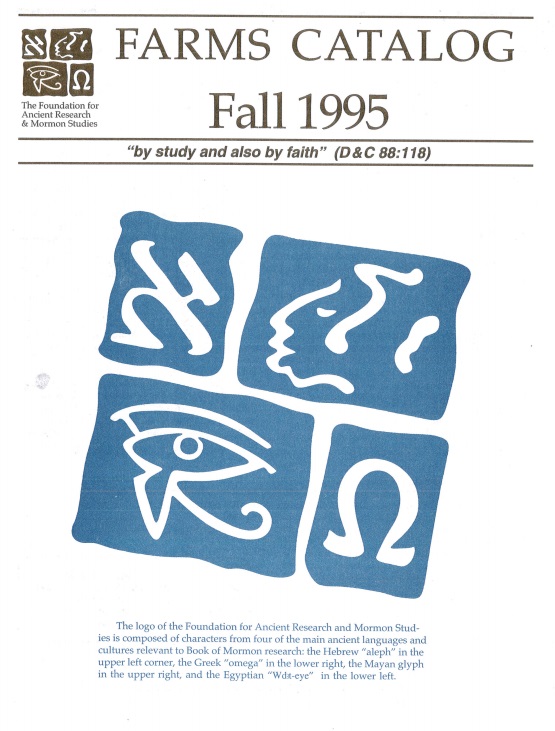
Book of Mormon Central is so adamant that only one set of opinions is permissible that they've embedded M2C right in their logo.


It's the same logo that FARMS (which has promoted M2C for decades now) used before the principals left to form the Interpreter Foundation and Book of Mormon Central.


In early 2023, Book of Mormon Central changed its logo to a more generic starburst, but it has not changed its editorial insistence on only one acceptable interpretation of the Book of Mormon. The organization makes this explicit in its Spanish-language site. 


If the intellectuals in the citation cartel heeded the guidance from the Gospel Topics Essays, there wouldn't be a citation cartel. 

They would (i) consider all relevant evidence and (ii) be open to alternative "interpretations" of the scriptures, the teachings of the prophets, and authentic historical documents--including an interpretation that corroborates and supports those teachings, instead of M2C/SITH which both expressly repudiate those teachings.

_____

To be clear, I agree with, embrace, and do not dispute, what Elder Ballard said about the essays being important. I encourage people to read and study the essays because they contain useful references to reliable sources. 

But nowhere have Church leaders stated, suggested, or implied that these essays were ever intended to replace the scriptures, the teachings of the prophets, or authentic historical documents. 

Nevertheless, some people (including my critics) refer to the essays as though they have been canonized. 

The introduction to the Gospel Topics Essays is here: 


The introduction also says, "The Church places great emphasis on knowledge and on the importance of being well informed about Church history, doctrine, and practices." 

That, too, perfectly expresses my approach to Church history, doctrine and practices. I encourage people to be well informed so they can make informed decisions. As President Nelson has said, "Good inspiration is based upon good information." 

My objection to the citation cartel is not that they promote different interpretations than I do. That's fine with me. I fully endorse the concept of multiple working hypotheses. My problem with the cartel is the same as my problem with the critics such as CES Letter and Mormon Stories; both groups deprive people of good information through censorship and sophistry purely to promote their respective agendas.
_____

To repeat: the Gospel Topics Essays have been revised in the past and can be revised and improved at any moment. 

I point out errors and omissions in the essays because I'm hopeful that the essays will continue to be improved, particularly by including the reliable sources from the Joseph Smith Papers that have so far been omitted.
_____

A memo dated Sept. 9 from the church’s "Priesthood Department" to "General Authorities; Area Seventies; Stake, Mission, and District Presidents; Bishops and Branch Presidents" explains the purpose of — and audience for — the essays.

"The purpose of the Gospel Topics section is to provide accurate and transparent information on church history and doctrine within the framework of faith... When church members have questions regarding [LDS] history and doctrine, possibly arising when detractors spread misinformation and doubt, you may want to direct their attention to these resources."

Leaders should emphasize that "prayer, regular study of the scriptures and the teachings of the living prophets, the exercise of faith, and humility are fundamental to receiving inspired answers to sincere questions."

JSP promoting SITH again

In the pursuit of clarity, charity and understanding, and with the hope that errors can be corrected and commentary in the Joseph Smith Pape...