Get the old stories right

Walter Kirn@walterkirn Old news is more important than new news because new news is built on top of it. When you are renovating a structure you don't start with the roof but with the foundation. Let's go back and get the old stories right. Otherwise nothing will be right, from here on out.

Friday, May 6, 2022

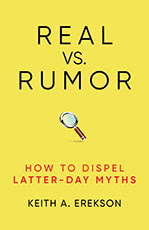
Real vs. Rumor, part 3: historians "knowing" vs. reporting - the "most common question" example

Brother Erekson, Director of the Church History Library in Salt Lake City, says that the most common question he receives is "Do you have the sword of Laban?"

That's a surprising question, in a way, but it reflects the ongoing confusion about the early events surrounding the Hill Cumorah. Based on Erekson's explanation in his book, that confusion is destined to linger, if not intensify.

_____

One of the strangest aspects of Brother Erekson's book is the way he disregards his own advice and standards regarding historical analysis to comply with particular interpretations of Church history that accommodate modern theories. 

Another surprising habit among many LDS historians is their penchant for declaring what they "know" instead of merely reporting the historical evidence. Today we'll look at a specific example.

While surprising, Brother Erekson's approach is not unique. Many current LDS historians take for granted the twin theories of M2C (the "Mesoamerican/two-Cumorahs" theory of Book of Mormon geography) and SITH (the "stone-in-the-hat" theory of Book of Mormon translation).

On page 2, Erekson writes, "Antagonists distort the Church's history, and some Saints abandon their faith because they can't make sense of the past or discern present manipulations." But then he proceeds to do exactly what he accuses "antagonists" of doing.

On page 29, under the heading Show Me the Evidence, Erekson offers this important suggestion:

Every time we hear a quote or story or rumor we must respond with "Show me the evidence." After asking about what we know and what we don't, we should also ask "How do we know it?"

I couldn't agree more. But then let's look at the next paragraph.

Let me illustrate this process by answering the most common question I receive when people learn that I'm the director of the Church History Library--"Do you have the sword of Laban?" The short answer is "No," but there is more to the response. I don't know where the sword is now or whether it has even been used since the late 1820s, but I do know that Joseph Smith saw the sword in the box with the plates, that Moroni showed it to the Three Witnesses, and that Oliver reported seeing the sword unsheathed on a table in a vision about a cave of records. Once we establish what we know, then we ask, "How do we know it?" (emphasis added)

This is significant for several reasons, but notice that this is the most common question people ask of the director of the Church History Library, and he gives them an answer based on M2C, not on the historical sources!

To understand how manipulative this paragraph is, we have to first understand that many current LDS historians (particularly those at BYU and the Church History Department) embrace the premise of M2C; i.e., they agree with the M2C citation cartel that Joseph and Oliver misled everyone about the Hill Cumorah (Mormon 6:6) being in New York. 

An essential element of M2C is the claim that the repository of records (Mormon 6:6) is actually somewhere in southern Mexico (or elsewhere--actually, anywhere in the world except western New York). This is critical for M2C because they also insist that the final battles of the Jaredites and Nephites could not have happened in New York.

Thus, our M2C scholars teach that the "hill in New York" where Moroni built the stone box was wrongly named Cumorah because of a false tradition that Joseph Smith inexplicably embraced. They furthermore teach that all the prophets and apostles who reiterated the New York Cumorah, including members of the First Presidency speaking in General Conference, compounded the error by misleading the Church, the Latter-day Saints, and the world at large for generations until the M2C scholars discovered the mistake and corrected the prophets by locating Cumorah in southern Mexico.

That may seem like hyperbole, but that's the reality as we've seen on this blog many times. M2C is depicted in the logo of Book of Mormon Central and in the writings and presentations of all the members of the M2C citation cartel. The cartel expressly repudiates the teachings of the prophets, although they mute their position with sophistry and laundry-list arguments as we discussed yesterday.

_____

To sustain the M2C narrative, these historians consistently (in the words of Brother Erekson) "distort the Church's history," causing an unnecessary faith crises among Latter-day Saints who "can't make sense of the past or discern present manipulations."

M2C is the reason why the Saints book, volume 1, created a false historical narrative present by depicting early Latter-day Saints as though they never heard of Cumorah.

M2C is the reason why the Gospel Topics entry on Book of Mormon geography ignores Cumorah completely, as if the historical record doesn't even exist.

Display in the North Visitors Center
on Temple Square
M2C is the reason why the North Visitors Center on Temple Square depicted two Cumorahs: one in Mexico where Mormon supposedly abridged the records and kept the repository of all the Nephite records (Mormon 6:6), and one in New York where Moroni supposedly deposited the plates, the sword of Laban, and the Liahona after traveling thousands of miles from the Mexican Cumorah.

Thankfully, the North Visitors Center no longer exists, so visitors will no longer be indoctrinated into believing M2C is official Church doctrine. But plenty of Latter-day Saints and other visitors were subjected to M2C for many years.


And M2C is the reason why Brother Erekson manipulates the historical sources as I've bolded above, as we'll see next.

_____

Brother Erekson applies his "Show Me the Evidence" rule with this table on pages 30-31. For clarity, the text is reproduced to the right of the images.

Recall that he introduced this table by testifying "I do know that Joseph Smith saw the sword in the box with the plates."

How does he know that?

Because of an 1886 statement by Joseph's sister Catherine that doesn't even say what Brother Erekson claims.

In fact, none of what Brother Erekson claims "we know" is based on historical evidence. All three are merely his M2C-inspired interpretations of selected sources that contradict other, more credible sources.

It's stunning. Let's sort it out.


What We Know

How We Know It

Joseph Smith saw the sword in the stone box with the plates.

His sister Catherine stated in 1886 that Joseph "went frequently to the hill, and upon returning he would tell us, 'I have seen the records, also the brass plates and the sword of Laban with the breast plate and the interpreters.'

Moroni showed the sword to the Three Witnesses

The Lord promised to show the sword to the Three Witnesses in a revelation (D&C 17:1), and in the late 1870s and early 1880s, David Whitmer told multiple interviewers that Moroni "exhibited to them the plates, the sword of Laban, the Directors which were given to Lehi (called Liahona), the Urim and Thummim, and other records."

Joseph and Oliver Cowdery saw the sword on a table in a cave in a vision.

Brigham Young related the story in a talk in June 1877, noting that Oliver and Joseph "walked into a cave" containing "more plates than probably many wagon


loads." The first time they visited, the sword hung on the wall, but "when they went again it had been taken down and laid upon the table across the gold plates; it was unsheathed, and on it was written these words: 'This sword will never be sheathed again until the kingdoms of this world become the kingdom of our God and his Christ.'" Brigham said he heard this story from Oliver and from Joseph's brother Don Carlos. Three people recorded hearing Brigham Young tell this story, two people recorded hearing it from David Whitmer, and one reported hearing it from Martin Harris.


_____

We begin with Katherine's statement. Katherine wrote a letter to the RLDS publication Saints' Herald in 1886, when she was 73 years old. (She was born on July 8, 1813, making her 14 years old when Joseph obtained the plates in 1827.) This was nearly 60 years after the events. You can read her letter here, on page 260. https://www.latterdaytruth.org/pdf/100200.pdf

In her letter, she doesn't provide dates or details, but she does say Joseph went "frequently" to the hill. 

However, we know from Joseph's account that he went once a year to the hill until he obtained the plates. On another occasion in early 1827 he met with Moroni "as I passed by the Hill of Cumorah," but because that account identified the hill as Cumorah our historians never refer to it.

Joseph's own account, canonized in the Pearl of Great Price, differs from Katherine's in another respect. Moroni told Joseph there were three items in the stone box, which Joseph verified:

Having removed the earth, I obtained a lever, which I got fixed under the edge of the stone, and with a little exertion raised it up. I looked in, and there indeed did I behold the plates, the Urim and Thummim, and the breastplate, as stated by the messenger. The box in which they lay was formed by laying stones together in some kind of cement. In the bottom of the box were laid two stones crossways of the box, and on these stones lay the plates and the other things with them.

(Joseph Smith—History 1:52)

Oliver Cowdery provided a more detailed description in Letter VIII, emphasizing that the box was large enough to accommodate the breastplate as well as the plates and the interpreters, but there was not even a suggestion that other items were in the stone box.

When considering Katherine's statement, we naturally wonder, why would Moroni put the brass plates, the sword of Laban, and the Liahona in the stone box with the abridged plates, breastplate and interpreters? They would serve no purpose; they wouldn't even be meaningful to Joseph until he had translated the plates. Joseph never said or implied that Moroni explained such additional items. 

Plus, as difficult as it is to believe (according to M2C) that Moroni hauled a 60-pound set of abridged plates from Mexico to New York, it's even less credible that he also hauled a set of brass plates with the sword of Laban and the Liahona. 

Nevertheless, Brother Erekson disregards all these considerations and testifies to visitors at the Church History Library that he "knows" Joseph "saw the sword in the box with the plates." 

What could be more disturbing to faith than to have the Director of the Church History Library testifying to the truth of his interpretation of a 60-year-old account that both (i) contradicts what Joseph and Oliver taught and (ii) doesn't make any sense?

While Erekson's interpretation is problematic at best, Katherine's statement can easily be reconciled with other historical accounts--including the account from Oliver regarding the repository of records in the Hill Cumorah that we'll discuss below. If, as Oliver claimed, he and Joseph entered the repository on multiple occasions, then Joseph would not only have seen the brass plates, sword of Laban, and Liahona but could have told his family about them as Katherine claimed 60 years later. The imprecision in her letter is easily attributed to her late recollection of events that took place when she was a teenager.

IOW, there is no need for Erekson or anyone else to imply (let alone testify!) that the detailed narratives from Joseph and Oliver were wrong or incomplete. 

No need, we should say, except for the need to support the M2C narrative. 


BTW, whoever created the display of the "hill in New York" (the "false" Cumorah) in the North Visitors Center agreed with Brother Erekson. 

The diorama and associated video depicts Moroni putting the sword of Laban and Liahona into the stone box, along with the plates. 

Except they forgot to show the brass plates...

It was one thing for the North Visitors Center to teach this bizarre contradiction to what Joseph and Oliver taught, but they actually replicated the same display at the Hill Cumorah visitors center in New York!

_____

Erekson's second statement of "What We Know" is that "Moroni showed the sword to the Three Witnesses." As evidence, he cites D&C 17:1 and late statements by David Whitmer.

This is not serious historical analysis. 

First, D&C 17:1 was prospective. It was a promise of a future event, not an account of an event that had taken place.

Second, D&C 17:1 is bifurcated:

Behold, I say unto you, that you must rely upon my word, which if you do with full purpose of heart, you shall have a view of the plates, and also of the breastplate, the sword of Laban, the Urim and Thummim, which were given to the brother of Jared upon the mount, when he talked with the Lord face to face, and the miraculous directors which were given to Lehi while in the wilderness, on the borders of the Red Sea. (Doctrine and Covenants 17:1)

The "and also" suggests or implies that there would be two separate viewings.

Third, the official testimony of the Three Witnesses mentions only the plates: "we declare with words of soberness, that an angel of God came down from heaven, and he brought and laid before our eyes, that we beheld and saw the plates, and the engravings thereon."

Logically, we could say that their testimony that they saw the plates doesn't necessarily mean they didn't also see the other objects at the same time. But given the bifurcated nature of D&C 17:1 and the absence of any record from Joseph Smith, Martin Harris or Oliver Cowdery that they saw these artifacts on this occasion, it is hardly viable to testify that we "know" they all saw all these objects on that occasion, based solely on David Whitmer's statements, particularly when David explained that Martin was not present on the occasion.

The first known statement by David about seeing the other objects (in addition to the plates) is from an interview he had with Joseph F. Smith and Orson Pratt in September 1878. He repeated the essence of that account in 1881 and 1882.

Here is the March 1, 1882, account from the Saints' Herald

We then got up and sat on the log and were talking, when all at once a light came down from above us and encircled us for quite a little distance around; and the angel stood before us. He was dressed in white, and spoke and called me by name and said 'Blessed is he that keepeth His commandments.' This is all that I heard the angel say. A table was set before us and on it the records were placed. The Records of the Nephites, from which the Book of Mormon was translated, the brass plates, the Ball of Directors, the sword of Laban and other plates. While we were viewing them the voice of' God spoke out of heaven saying that the Book was true and the translation correct."

https://www.latterdaytruth.org/pdf/100196.pdf p. 68

While this account doesn't directly contradict the official statement by the Three Witnesses, it includes details that had been discussed by others as early as 1855, but in a completely different context.

Other than David's accounts, all other accounts (accounts which preceded David's) of the table bearing the records, sword of Laban, and other artifacts involve the repository in the Hill Cumorah referenced in Mormon 6:6. Significantly, David's accounts all post-date the detailed 1877 account related by Brigham Young two months before his death. 

The 1855 account has David accompanying Joseph, Hyrum and Oliver to the repository in the Hill Cumorah, where they saw the angel and the artifacts.

Ordinarily, historians prefer earlier accounts over later ones. Ordinarily, they prefer corroborated accounts by multiple witnesses over isolated accounts by one witness. 

If we apply those preferences to David's account of seeing the artifacts on a table, the more plausible explanation is that David conflated two separate events; i.e., he related his experience as one of the Three Witnesses, consistent with the formal Testimony of the Three Witnesses, but he added his experience seeing the other artifacts in the repository in Cumorah.

This is not only plausible but justifiable, given that David sought to discourage treasure seekers from digging in the Hill Cumorah. In terms of the authenticity of his testimony, what mattered is his declaration that he physically observed the artifacts, not when and where he saw them. 

At any rate, to state as a fact that the Three Witnesses saw these artifacts fails to account for the absence of Martin Harris from the event, regardless of when and where it took place.

This is all relevant to the question of M2C because if, as others related, the artifacts were actually observed in the repository inside the New York Cumorah, then the teachings of the prophets about the New York Cumorah are corroborated and vindicated. 

_____

The third thing Erekson says we "know" is that "Joseph and Oliver Cowdery saw the sword on a table in a cave in a vision.

With all the sources relating the event as a physical experience, we naturally wonder why Erekson would frame the event as a mere "vision." The source for that framing is a statement by Heber C. Kimball, who when responding to a comment about the handcart pioneers, said, "How does it compare with the vision that Joseph and others had, when they went into a cave in the hill Cumorah and saw more records than ten men could carry?

https://www.josephsmithfoundation.org/journalofdiscourses/reporters/g-d-watt/emigration-the-saints-warned-to-repent-or-judgments-will-come-upon-them/

M2C advocates portray the event as a "vision" based on Kimball's use of the term, reasoning that if it was not an actual physical event in New York, it could instead be merely some kind of spiritual sight of the actual repository which must, according to M2C, be located in southern Mexico. 

There are several problems with this framing.

First, Kimball preceded this sentence with a very literal reference to the hill Cumorah. 

Brother Mills mentioned in his song, that crossing the Plains with handcarts was one of the greatest events that ever transpired in this Church. I will admit that it is an important event, successfully testing another method for gathering Israel, but its importance is small in comparison with the visitation of the angel of God to the Prophet Joseph, and with the reception of the sacred records from the hand of Moroni at the hill Cumorah.

Second, Kimball said they had a vision "when they went into a cave in the hill Cumorah," another statement of physicality. 

Third, while the term "vision" can refer to a revelation, or imaginary, other supernatural presentation, the 1828 Webster's dictionary offers as the first connotation "the act of seeing external objects; actual sight." That connotation is consistent with all the other accounts of the repository, none of which refer to a "vision."

Fourth, if the term "vision" can refer only to a metaphysical experience, then what can we make of the "First Vision" during which Joseph claimed he saw Christ and God in a literal, physical sense? 

At any rate, the historical evidence doesn't support the "vision" framing.

Erekson cites Cameron Packer's important article, "Cumorah's Cave," which is online here:  

https://scholarsarchive.byu.edu/cgi/viewcontent.cgi?article=1360&context=jbms

Packer's first reference is the William Horne Dame Diary, dated 14 January 1855, which states, "Attended meeting a discourse from W. W. Phelps. He related a story told him by Hyrum Smith which was as follows: Joseph, Hyrum, Cowdery & Whitmere went to the hill Cormorah. As they were walking up the hill, a door opened and they walked into a room about 16 ft square. In that room was an angel and a trunk. On that trunk lay a book of Mormon & gold plates, Laban’s sword, Aaron’s brestplate."

Heber C. Kimball gave his "vision" version in a sermon on 28 September 1856. Additional accounts from 1867, 1869, 1873, and 1874 corroborate the actual visit to the repository in the Hill Cumorah. 

Finally, on 17 June 1877, just two months before he died, Brigham Young related the account that Erekson excepts in the third panel of the table. The full account emphasizes the physical reality of the experience. More than one experience, actually; Brigham related at least two occasions when Joseph and Oliver entered the repository.

In light of this historical evidence, consider again Erekson's summary of "What We Know" here:

"Joseph and Oliver Cowdery saw the sword on a table in a cave in a vision."

That statement cannot be reasonably characterized as anything other than "distorting the Church's history... [so that Latter-day Saints] can't make sense of the past or discern present manipulations." 

_____

To summarize:

Brother Erekson, as Director of the Church History Library, fields all kinds of questions, but his number one question is, "Do you have the sword of Laban?"

The question reflects the serious confusion among Latter-day Saints about the early events of the restoration, particularly those involving the plates and the Hill Cumorah. 

An answer based on actual historical accounts would be simple and clear; i.e., Joseph, Oliver, and others saw the sword of Laban in the repository in the Hill Cumorah in New York multiple times, but it remains with the other Nephite records and artifacts. We don't know where those are now, except David Whitmer and Oliver Cowdery said they are no longer in the repository in the Hill Cumorah. David did say they are not far from there, however.

Instead, Brother Erekson testifies of three facts that contradict the narrative given to us by Joseph and Oliver in favor of academic interpretations promoted by M2C advocates that are intended to accommodate M2C, even though they distort Church history and leave the Latter-day Saints unable to make sense of the past or to discern present manipulation.

_____

The other parts are here:


Thursday, April 28, 2022

Real vs. Rumor part 2: the youth

The most perplexing aspect of the book is the way Brother Erekson does not follow his own advice about how to approach history. We'll look at several examples in coming posts, but in this part 2, we want to focus on the impact of Church history issues on the youth of the Church.

On page 156, Brother Erekson writes,

"Does anyone even run into that faith-challenging, anti-Mormon stuff?" an older woman asked.

"The only people who do are the ones hanging out in bars and places like that," said a man of her same generation.

I was surprised how prevalent this assumption is, so I began to gather evidence. During the summer of 2019, I spoke to hundreds of Latter-day Saint youth at conferences and firesides. Using an anonymous polling system that operated through their phones, they responded to this question: "Have you ever encountered something that challenged your testimony?" The "yes" results were usually in the 90 percent range and never less than 80 percent. The most surprised people in the room were the adults!

I have questions. 

First, the opening dialogue isn't plausible, but let's say they are accurate quotations nevertheless. Who talks like that? Who thinks like that? And what does hanging out in bars have to do with anti-Mormon literature? The conversation depicted here reflects extreme isolation and naivete, more of a parody than an authentic scenario.

Is relative exposure to "anti-Mormon stuff" a generational difference? While the Internet has made materials far more accessible, "anti-Mormon stuff" has been around since the inception of the Restoration. Maybe in pockets of Utah or Idaho there are Latter-day Saints who never "run into" these things, but that's definitely an exception.

Alternatively, the opening dialogue may reflect the "lazy learners" who don't ask questions and are impervious to outside literature or even conversations with people outside their bubble.

I don't know how old one has to be to qualify as "older" but when I was a 19-year-old missionary, I had long since heard the "anti-Mormon" arguments that I encountered during my mission. So had all of my companions. We discussed these things. And this was decades ago.

Another question: why would the adults be surprised at the poll? I don't see any indication that the adults themselves were polled, so it's not clear how Erekson knows the adults were the most surprised people. Are these parents who never talk with their kids? Church leaders who never engage with the youth they are responsible to lead?

Again, let's assume everything Erekson reports here is accurate. If so, that leads to the inescapable conclusion that there are adult Latter-day Saints who are poorly informed themselves, don't talk with their kids, and have fragile testimonies that have never been challenged. That doesn't bode well.

Then again, the question "Have you ever encountered something that challenged your testimony?" is so open-ended it doesn't help us much. People would answer yes if they felt a prayer went unanswered, if they thought about the evil in the world (war, crime, hunger, etc.), or if they read the CES Letter. 

For many Latter-day Saints, it is the teachings of certain LDS intellectuals that are faith challenging. Lately some of our own LDS intellectuals are trying to persuade us that Joseph Smith never really translated anything, that he didn't even use the plates, and that he and Oliver misled everyone about the Nephite interpreters and the New York Cumorah.

We have examples of these teachings right in Real vs. Rumor!

It would be interesting if Brother Erekson had polled the youth regarding their reaction to the stone-in-the-hat (SITH) narrative. Or the M2C (Mesoamerican/two-Cumorahs theory). In my experience, few people find SITH either credible or inspiring. The well-known declines in activity and conversion rates correlate to this SITH narrative, which became popular in the 1990s and early 2000s. While correlation is not causation, it's difficult to believe that the SITH tactic employed by Mormonism Unvailed in 1834 would not have the intended impact when it is so fully embraced by LDS intellectuals that it is now in our curriculum.

M2C explicitly rejects the teachings of the prophets about Cumorah. When LDS scholars teach the youth that the prophets were wrong about Cumorah, it hardly builds faith.

_____

Monday, April 25, 2022

Real vs Rumor part 1: Dispelling Latter-day myths


This will be a short series on the important book Real vs. Rumor by Keith A. Erekson. His website is here:

https://www.keitherekson.com/books/real-vs-rumor/

Erekson does an exceptional job discussing the issues presented by historical research. But in some specific instances, he doesn't follow his own advice, as we'll see. It's quite surprising to see these instances, so we'll discuss them in some depth.

Part 1 is an excerpt from an interview about the book.

Sarah Jane Weaver: Well, from the earliest days that I had the opportunity to interact with you, you have been promoting this idea that we should be telling accurate and better stories. Why is it so important that our history and the retelling of history be accurate?

4:45  

Keith A. Erekson: Well, I think there are several levels where accuracy matters. At the most basic level, we want to get the story right and we want to be true to the people who lived it. It was their experience, so we don’t want to distort their experience or turn it into something that it wasn’t.

But I think for Latter-day Saints in particular, history is so much a part of our worship in our devotions. We sing hymns about the history of the Church, we study the history of the Church, texts from our history have become part of our scripture, and so we’re using these texts and using our history as ways to learn about God. And so, in that context, having an accurate understanding of history and God’s dealings with people helps us have an accurate understanding of God.

Sarah Jane Weaver: Well, it is true that our scriptures, including the Book of Mormon, are actually history books.

5:42  

Keith A. Erekson: They are. They’re full of stories. They’re full of what historians today call primary sources or texts. There are letters in the scriptures, there are sermons in the scriptures, all these kinds of records that have been carried down to us for our edification.

Sarah Jane Weaver: And tell us what happens when we promote stories that aren’t true or that aren’t entirely true.

6:07  

Keith A. Erekson: A couple of things happen when we tell those kinds of stories, and some of the most damaging results are for the hearers. If we continually tell stories that are partially true or left out significant detail, or left out whole groups of people entirely — the challenge is when lots of things are left out, people fail to see themselves in history. They fail to see the connections, and they fail to see — for example, if we’re trying to learn how God blesses people, how God protects people, how God watches over people, but you never see anyone in the story that looks like you, then you start to wonder: “Well, does God protect me? I see God protects those other people in the story. But what about people like me?” 

I think it also can be harmful if people then later learn: “Oh, there are parts of the story that they left out. Well, why did they do that?” Sometimes it can lead to feeling betrayed, or even singled out: “Well, why would they leave out my kind of people if my people were in the story?” And by my kind of people, we can mean all kinds of things. This could be from the nation that you live. Many stories from Church history leave out women — half of the Church’s population, or more, and so we have to be better at telling the complete and accurate stories.

https://www.thechurchnews.com/podcast/2021-08-10/episode-43-church-history-library-director-keith-a-erekson-on-dispelling-latter-day-myths-rumors-221819

_____

The other parts are here:


Sunday, February 13, 2022

From Darkness Unto Light?

In 1834-5, Joseph Smith and Oliver Cowdery wrote a series of essays on Church history and doctrine (the first "gospel topics essays") to refute an 1834 anti-Mormon book titled Mormonism Unvailed.

Now some LDS historians are instead using Mormonism Unvailed to refute Joseph Smith and Oliver Cowdery. 

This is most evident in a book titled From Darkness unto Light.

Among other things, the authors claim that Joseph Smith didn't really use the plates when he translated. Instead, according to these historians, the plates were left covered by a cloth throughout the translation process and Joseph merely read the words of a seer stone in the bottom of a hat.

In my view, this revisionist narrative of history is a grave mistake.

While it's fine for people to believe and teach whatever they want, at a minimum historians have an ethical and professional responsibility to provide all the relevant historical sources so people can make informed decisions. 

But as a result of this revisionist history, Latter-day Saints are being taught the stone-in-the-hat narrative (SITH) instead of what Joseph and Oliver taught. Even missionaries are instructed to teach people about SITH. This is causing confusion and uncertainty.

One argument in favor of SITH that people make is that it doesn't matter how Joseph produced the Book of Mormon because people gain a testimony of its truthfulness when they read the book and pray about it. The shorthand version of this argument is that "it doesn't matter which stone(s) Joseph used because either way, he translated by the "gift and power of God."

I get that argument, which many Latter-day Saints have accepted. But SITH has led many Latter-day Saints to question their faith. 

The historical record is clear and unambiguous that Joseph and Oliver repeatedly emphasized that Joseph used the Urim and Thummim that came with the plates to "translate the engravings" on the plates, as instructed by the Lord. (D&C 10:41)

The conflict between what Joseph and Oliver taught and the various SITH statements has led one prominent LDS scholar, Royal Skousen, to conclude that "Joseph Smith’s claim that he used the Urim and Thummim is only partially true [regarding the lost 116 pages]; and Oliver Cowdery’s statements that Joseph used the original instrument while he, Oliver, was the scribe appear to be intentionally misleading."

Brother Skousen may be the first LDS scholar to articulate the inevitable conclusion of the SITH narrative, but many Latter-day Saints (and especially former LDS and never LDS) have reached the same conclusion.

That is why I think SITH is a disaster, and it is exactly the the same reason why Oliver and Joseph responded to the claims of Mormonism Unvailed in the first place, all the way back in 1834 and 1835.

I emphasize that these are merely my personal conclusions, based on my own research and careful reading of this book and the sources they cite and omit. None of this is personal, of course; we're merely dealing with words on pages, not people. The revisionist historians are faithful LDS, careful scholars, and nice people. 

I just hope people who read this book don't defer to the authors' opinions, but instead continue their study to include material the authors omitted--especially what Joseph and Oliver and their contemporary and successor Church leaders said. 

[BTW, by promoting the narrative that Joseph and Oliver misled everyone about the origin of the Book of Mormon, the book lends credence to another narrative that Joseph and Oliver misled everyone about the setting of the Book of Mormon, known as M2C (the Mesoamerican/two-Cumorahs theory).
_____

In October 1834, Oliver Cowdery published the first of a series of eight essays he wrote with the assistance of Joseph Smith, labeling them as "letters." An excerpt from Letter 1 is canonized in JS-History, note 1.

I call these eight essays the first "gospel topics essays" because they address important issues involving Church history and doctrine that remain relevant today. They were originally published as letters to W.W. Phelps in the Church's newspaper in Kirtland, Ohio, titled the Latter Day Saints' Messenger and Advocate.

For example, essay (letter) IV (1835) explains that Moroni

"said this history was written and deposited not far from that place, and that it was our brother’s privilege, if obedient to the commandments of the Lord, to obtain and translate the same by the means of the Urim and Thummim, which were deposited for that purpose with the record."


This not only corroborates what Joseph and Oliver said elsewhere, but it leaves no room for the notion that Joseph had the privilege of "translating" the record with a stone he found in a well without even looking at the plates.

And yet, few modern Latter-day Saints have ever read Oliver's essays, or even know about them. 

Letter IV in the Messenger and Advocate is available online here:
https://archive.org/stream/latterdaysaintsm01unse#page/76/mode/2up/search/Letter+IV

Soon after the eighth essay was published, President Frederick G. Williams, Second Counselor in the First Presidency, began copying them into Joseph's personal history. You can see them in the Joseph Smith Papers today, such as essay IV here:
http://www.josephsmithpapers.org/paper-summary/history-1834-1836/64

Also in October 1834, the anti-Mormon book Mormonism Unvailed was published in nearby Painesville, Ohio. You can see it here:
https://archive.org/details/mormonismunvaile00howe

Here is the passage that describes SITH, which is quoted nearly verbatim by modern LDS scholars who promote SITH. 

The translation finally commenced. They were found to contain a language not now known upon the earth which they termed "reformed Egyptian characters." The plates, therefore, which had been so much talked of, were found to be of no manner of use. After all, the Lord showed and communicated to him every word and letter of the Book. Instead of looking at the characters inscribed upon the plates, the prophet was obliged to resort to the old "peep stone," which he formerly used in money-digging. This he placed in a hat, or box, into which he also thrust his face. Through the stone he could then discover a single word at a time, which he repeated aloud to his amanuensis, who committed it to paper, when another word would immediately appear, and thus the performance continued to the end of the book.

https://archive.org/details/mormonismunvaile00howe/page/18

The influence of Mormonism Unvailed persisted for years. (Actually, with the book From Darkness Unto Light its influence has been rejuvenated.)

During Joseph's lifetime, President Cowdery's essays were republished in Church newspapers for everyone to read and re-read them. This includes the Times and Seasons, the Millennial Star, the Gospel Reflector, and The Prophet. The essays were cited by Church leaders. An excerpt from Letter I is canonized in Joseph Smith-History. The essays were published again in Utah in the Improvement Era when Joseph F. Smith was the editor.

Yet these essays have never been published in the Ensign or Liahona. They have been essentially forgotten and overlooked. Worse, they have been specifically repudiated by some well known LDS scholars who disagree with what Joseph and Oliver said about the origin and setting of the Book of Mormon.

Today, it seems the revisionist historians rely more on Mormonism Unvailed than on President Cowdery's letters.
_____

Richard L. Bushman's Foreword foreshadows some of the problems I found in this book. Original in blue.

p. v. “Books like this one will bring Latter-day Saint readers up to date on the results of the latest historical research. While, like all histories, From Darkness unto Light is necessarily an interpretation, the authors base their story firmly on the original sources. They get down to what historians consider to be the bedrock of historical constructions.”

I found the historical references in this book very helpful. But, as we'll see, there is a lot of interpretation in this book. I mean, a lot. The authors tell us what Joseph was thinking, what motivated him, etc. That's fine when it is acknowledged, but several important and relevant original sources are omitted in the book. Why? The only reason I can think of is because these original sources contradict the authors' interpretations. This is problematic.

“Joseph probably first used the stones set in spectacles that came with the plates, and then, for most of the translation period, substituted one of the stones he had found. Joseph put the seer stone in a hat to exclude the light and read off the translated text by looking in the stone. All the while, the plates lay wrapped in a cloth on the table. Apparently Joseph did not look at the plates through most of the translation.”

To persuade readers of this conclusion, the authors simply omit contrary evidence. That makes their conclusion appear obvious, but there's another way to interpret the same evidence that is consistent with both the evidence they consider and the evidence they omit. From my perspective, all the evidence, when considered together, is consistent with the traditional narrative that Joseph did actually use the plates and sometimes used the hat during the final part of the translation process when he read what appeared on the stone. I disagree with the authors' interpretation because I think Joseph actually translated the engravings on the plates, as the scriptures state. 

“Failure to acknowledge these factual accounts, almost all of them in friendly sources, can devastate Latter-day Saints who run across them. Feeling that the Church has covered up the truth, they become disillusioned and even angry. This book is an attempt to repair the misconceptions so that the next generation of Latter-day Saints will be better informed.”

I agree with this concept, but in my view, the book covers up critical original sources that contradict the authors' conclusions. Consequently, the book creates more misconceptions that will have far-reaching consequences now that the Church History Department has essentially adopted the authors' conclusions.

“For years Mormon scholars simply disregarded critical sources, such as the affidavits concerning the Smith family in E..D. Howe’s Mormonism Unvailed… Everything has to be examined and evaluated. MacKay and Dirkmaat work on the principle that bias must be taken into account in analyzing any historical sources. The art of the historian is to extract useful information from original sources whether negative or positive.”

President Cowdery considered Mormonism Unvailed as soon as it was published. That's why he emphasized he was using facts when he wrote the eight essays. Yet the authors ignore much of what President Cowdery wrote and instead rely more on Mormonism Unvailed, as I indicated at the outset of this post.
_____

Here are more examples from the book. 

The book From Darkness unto Light sets out the theory that when Joseph referred to the "Urim and Thummim" he really meant both the seer stone he found in a well and the interpreters that came with the plates. Let's call this the "expansive U&T definition."

"By at least 1833, Joseph Smith and members of the Church began using the biblical term "Urim and Thummim" to refer to any seer stone, including seer stones Joseph Smith found before 1827."

[see discussion below for citation]

Readers who rely on the authors' references and citations might be persuaded to accept their theory. But their theory would be more persuasive if they presented all the evidence instead of omitting key sources.

This post about From Darkness Unto Light is intended to provide the background information that the authors apparently overlooked or forgot to include in their book for unexplained reasons.

Maybe after considering all the evidence, readers would still accept the expansive U&T definition. Such readers would at least be making an informed decision.

Here's a problem. The 1835 book Mormonism Unvailed set out a sharp distinction between the "peep stone" that Joseph put in the hat, and the alternative explanation that Joseph used the Urim and Thummim. It sets forth the two alternatives on the very same page.


The authors mention the book Mormonism Unvailed 32 times (see below), but they forgot to include this passage that contradicts their theory.

Or maybe they omitted that passage intentionally because they knew it contradicted their theory.

You decide.

If, as the authors want us to believe, Joseph Smith began using the the "expansive U&T definition" in 1833, it makes no sense for Mormonism Unvailed to explain in 1835 that the seer (peep) stone theory (SITH, for stone-in-the-hat) is an alternative to the Urim and Thummim. 

Instead, as we'll discuss below, after the publication of Mormonism Unvailed, Joseph and Oliver consistently used the term Urim and Thummim to refer to the Nephite interpreters. I think they did so specifically to refute the SITH claims of Mormonism Unvailed, a book they denounced as I discussed here: http://www.ldshistoricalnarratives.com/2023/04/mormonism-unvailed-then-and-now.html

_____

In the chapter "Learning to Translate," the authors of From Darkness unto Light propose that 

"By at least 1833, Joseph Smith and members of the Church began using the biblical term "Urim and Thummim" to refer to any seer stone, including seer stones Joseph Smith found before 1827. 14

14.  See "The Book of Mormon," The Evening and the Morning Star, January 1833, 2. 

Why do they write "at least 1833" here? 

Footnote 14 refers to W.W. Phelps' 1833 explanation of the Urim and Thummim. For a while, historians thought this was the first usage of the term, so they assumed Phelps was the first to apply it. 

However, the 1833 theory has been discredited by the discovery of an earlier use of the term Urim and Thummim to refer to the Nephite interpreters which was published on August 5, 1832, when Orson Hyde and Samuel Smith told an audience in Boston that the translation “was made known by the spirit of the Lord through the medium of the Urim and Thummim." For a discussion, see 

https://www.mobom.org/urim-and-thummim-in-1832.

Even the Joseph Smith Papers include a citation to this source in a note, although in other areas the Phelps quotation is claimed to be the first usage of the term.

See note 5, here: https://www.josephsmithpapers.org/topic/urim-and-thummim

Now, look at the Phelps reference. It appears in a long article titled "The Book of Mormon" that sought to explain the book to the general public. Here's the excerpt:

It was translated by the gift and power of God, by an unlearned man, through the aid of a pair of Interpreters, or spectacles—(known, perhaps, in ancient days as Teraphim, or Urim and Thummim) and while it unfolds the history of the first inhabitants that settled this continent, it, at the same time, brings a oneness to scripture, like the days of the apostles;

(Evening and Morning Star I.8:58 ¶6)

Notice two things here. 

First, Phelps’ article was not inconsistent with prior use of the term Urim and Thummim, such as the way Orson and Samuel used the term, because Phelps was merely explaining the term using biblical terminology. 

Second, Phelps obviously used the term to apply specifically to the "pair of Interpreters, or spectacles." He neither said nor implied that the term would encompass a stone found in a well or any other object found before 1827. 

Thus, the only evidence cited by the authors directly contradicts their claim!
_____

This leaves us with the way Orson Hyde and Samuel Smith used the term. They neither said nor implied that Joseph used a seer stone. In that article, Samuel Smith and Orson Hyde are quoted in this Q&A session:

Q.-In what manner was the interpretation, or translation made known, and by whom was it written?

A.-It was made known by the spirit of the Lord through the medium of the Urim and Thummim; and was written partly by Oliver Cowdery, and partly by Martin Harris.

Q.-What do you mean by Urim and Thummim?

A.-The same as were used by the prophets of old, which were two crystal stones, placed in bows something in the form of spectacles, which were found with the plates.

Obviously, these answers are another refutation of SITH. They even specifically explain what they mean by "Urim and Thummim."

You can decide whether Orson and Samuel invented the term, or whether they heard that from someone else—presumably Joseph or Oliver.

Letter IV describes Moroni telling Joseph that it was his privilege “to obtain and translate the same by the means of the Urim and Thummim, which were deposited for that purpose with the record.” Moroni did not tell Joseph he had the privilege to translate the record "by any means he could or would discover." Moroni did not refer to any seer stone as a Urim and Thummim. 

When Oliver introduced these historical essays, he explained he was using original documents then in his possession. Perhaps he referred to the notebook he kept during the translation process, in which he recorded the things Joseph told him starting in April 1828. Maybe there were other documents, such as journal entries or letters. 

_____

While scholars have assumed or inferred that Moroni did not use the term, the evidence supports an alternative working hypothesis; i.e., the idea that it was Moroni who first used the term, that it was common understanding among Joseph's contemporaries, and that Phelps merely explained the use of the term to readers who were familiar with the Bible.

Related to this is the well-known insertion of the term "Urim and Thummim" into what is now D&C 10. 

As originally published in the 1833 Book of Commandments as Chapter IX, the passage read:

NOW, behold I say unto you, that because you delivered up so many writings, which you had power to translate, into the hands of a wicked man, you have lost them,

https://www.josephsmithpapers.org/paper-summary/book-of-commandments-1833/26

In the 1835 Doctrine and Covenants, the passage was changed to read this way:

1 Now, behold I say unto you, that because you delivered up those writings which you had power given unto you to translate, by the means of the Urim and Thummim, into the hands of a wicked man, you have lost them;

1 Now, behold, I say unto you, that because you delivered up those writings which you had power given unto you to translate by the means of the Urim and Thummim, into the hands of a wicked man, you have lost them.

(Doctrine and Covenants 10:1)

Some have suggested that this change was prompted by Phelps' coining the term in 1833. However, as we've seen, the term was used at least as early as 1832 in Boston.

What else happened between the 1833 Book of Commandments and the 1835 Doctrine and Covenants?

One event that may have prompted this change was the publication of Mormonism Unvailed, which, as we've seen, set forth SITH as an alternative to the use of the U&T.  

In my view, Joseph and Oliver added the term "Urim and Thummim" to the published revelation (i) to clarify the meaning of the passage, which was well known at the time but would not be in the future, and (ii) to refute the SITH claims of Mormonism Unvailed.

In fact, when Joseph described the translation, he made it perfectly clear, to the point of emphasis, that he used the Urim and Thummim that came with the plates, thereby precluding any reference to a seer stone he found in a well or anywhere else. It's difficult to imagine how he could have been any more clear and precise.

Joseph Smith's explanation in the Elders' Journal:

[Moroni] appeared unto me, and told me where they were; and gave me directions how to obtain them. I obtained them, and the Urim and Thummim with themby the means of which, I translated the plates; and thus came the book of Mormon.

https://www.josephsmithpapers.org/paper-summary/elders-journal-july-1838/11

He re-emphasized this point in the Wentworth letter:

With the records was found a curious instrument which the ancients called “Urim and Thummim,” which consisted of two transparent stones set in the rim of a bow fastened to a breastplate. Through the medium of the Urim and Thummim I translated the record by the gift, and power of God.

https://www.josephsmithpapers.org/paper-summary/church-history-1-march-1842/2

Notice, Joseph said the Urim and Thummim was with the records and that "the ancients" called the interpreters "Urim and Thummim." Moroni was an ancient, and his claim here is consistent with his claims in Joseph Smith-History. There is no room in this passage for a seer stone Joseph found in a well. 

Nevertheless, some LDS historians have rejected Joseph's claims and instead embraced the SITH narrative from Mormonism Unvailed. Informed readers can make their own informed decisions.

_____

BTW, the claim that the term Urim and Thummim was applied to the seer (peep) stones has been often repeated, even in a 2021 BYU Studies article I discussed here: 

https://www.bookofmormoncentralamerica.com/2021/11/byu-studies-strikes-again-part-3.html

_____

Continuing with the text of From Darkness Unto Light"Learning to Translate:" 

The name was apparently adopted to reflect the Old Testament's use of the Urim and Thummim that the high priest of Israel used for revelatory guidance. 15 

However, the Book of Mormon explains that the spectacles were handed down to Joseph Smith from ancient American prophets, and though the term was used in the early 1830s, they were not originally called the Urim and Thummim. 16. [emphasis added]

15 [citing Old Testament verses]

16. Joseph Smith, History, 1832, 6.

To claim as the authors do here that the interpreters "were not originally called the Urim and Thummim" defies what Joseph himself reported. 

34 He said there was a book deposited, written upon gold plates, giving an account of the former inhabitants of this continent, and the source from whence they sprang. He also said that the fulness of the everlasting Gospel was contained in it, as delivered by the Savior to the ancient inhabitants;

35 Also, that there were two stones in silver bows—and these stones, fastened to a breastplate, constituted what is called the Urim and Thummim—deposited with the plates; and the possession and use of these stones were what constituted “seers” in ancient or former times; and that God had prepared them for the purpose of translating the book.

(Joseph Smith—History 1:34–35)

 42 Again, he told me, that when I got those plates of which he had spoken—for the time that they should be obtained was not yet fulfilled—I should not show them to any person; neither the breastplate with the Urim and Thummim; only to those to whom I should be commanded to show them; if I did I should be destroyed. 

(Joseph Smith—History 1:42)

To be clear and accurate, the authors could have written "there is no extant document referring to the interpreters as the Urim and Thummim prior to 1832." But that is a far cry from their claim that the interpreters "were not originally called the Urim and Thummim." Obviously, we have no recording of what people said during those years, and scant records of what was reported about what they said.

Furthermore, the authors simply slide over the obvious problem with their theory; i.e., although we do have records of Joseph and Oliver specifically referring to the Nephite interpreters as the Urim and Thummim, we have no record of Joseph or Oliver ever using the term "seer stone" in connection with the translation.

Years later, in the Nauvoo era, Joseph did use the term Urim and Thummim in a broader context (D&C 130:10), but the only confusing aspect of this is the effort by modern SITH scholars to retroactively conflate the terms by claiming that, in 1835 and 1838, Joseph meant his seer stone when he referred to the Urim and Thummim.

_____

The first mention of Mormonism Unvailed appears in the Foreword. Richard Bushman sets out the underlying methodology of From Darkness unto Light.

For years Mormon scholars simply disregarded critical sources, such as the affidavits concerning the Smith family in E.D. Howe's Mormonism Unvailed. They felt the critical writings were too biased to be of any use. But in recent years, automatic exclusion of negative reports is no longer the practice. Everything has to be examined and evaluated. MacKay and Dirkmaat work on the principle that bias must be taken into account in analyzing any historical source. The art of the historian is to extract useful information from original sources whether negative or positive. The notes of From Darkness unto Light show the authors ranging through sources all across the spectrum. The result is a much enriched and compelling narrative, one that will hold up under critical scrutiny.

I like the way Richard explained "the art of historian" here, but he left a loophole. He should have written "extract useful information from all the original sources."  

Everyone can see that MacKay and Dirkmaat used original sources, but all historians (and polemicists) do that. The problem is that they simply omitted original sources that contradict their theory about the translation, including the sources most directly on point; i.e., the teachings of Joseph Smith and Oliver Cowdery, as we discussed here: https://www.bookofmormoncentralamerica.com/2022/07/from-darkness-unto-light-omitting.html

On the scale of historian mistakes, omitting the statements of the principals is near or at the top. 

Such omissions are obvious to informed readers, who easily recognize the historians' mistake.

The problem is much worse when historians deliberately omit statements from frequently cited sources solely because those statements contradict the historian's pet theory.

_____

It's not that the authors were unaware of Mormonism Unvailed. They cited the following pages of Mormonism Unvailed: 13-15, 236, 240-248, 252, 257-58, 260-261, 270, and 273.

The references to Mormonism Unvailed are listed below.

Retrieving the Plates. 

Note 30 E.D. Howe, Mormonism Unvailed (Painesville, OH: 1834), 240-48. [The note refers to this mindreading statement in the text "Chase likely refused [to make a case to hold the plates] because he doubted that Joseph could repay him for the materials and labor."]

Note 34. See Howe, Mormonism Unvailed, 240-48. [This note referred to Lawrence's involvement with Joseph Smith and mentioned that Lorenzo Saunders, who gave a similar account, "was likely dependent upon Chase's printed testimony in Mormonism Unvailed, but he likely also spoke with Chase."]

Note 36. If Chase's account is correct, which claimed that Samuel Lawrence went to the hill with Joseph Smith, the spectacles were revealed to him....Howe, Mormonism Unvailed, 240-48.

Note 49. Lucy Mack Smith, History, 1845, MS 65; Howe, Mormonism Unvailed, 245-46. [relating to a conjurer Chase hired to find the plates.]

Note 75. Howe, Mormonism Unvailed, 240-48.

Note 76. Chase claimed that Joseph had previously deceived Lawerence, convincing the latter to pay his way to Harmony, Pennsylvania by claiming that JOseph knew about a silver mine that never materialized. Howe, Mormonism Unvailed, 240-48.

Note 77. Lucy Mack Smith, History, 1845, MS 65; Howe, Mormonism Unvailed, 240-48. 

Escaping Palmyra and Copying Characters from the Gold Plates

Note 4. see also Howe, Mormonism Unvailed, 257-58.

Note 21. Lucy Smith wrote that the plates were "severely nailed up in a box and the box put into a strong cask made for the purpose the cask was then filled with beans and headed up as soon as it was ascertained." Lucy Mack Smith, History, 1845, book 6-7. See also Howe, Mormonism Unvailed, 13-15.

Note 31. Howe, Mormonism Unvailed, 257-58.

Note 38. Martin showed the characters he had copied from the plates to individuals throughout his lifetime.... See Howe, Mormonism Unvailed, 260-61.

Harris's Trip to the East

"He [Charles Anthon] wrote a letter to E.D. Howe in 1834 as Howe prepared his book Mormonism Unvailed, an expose criticizing the origins of the Church."

Note 6. See W.W. Phelps to E.D. Howe, 15 January 1831, in Mormonism Unvailed, 273. [discussing Martin Harris' stop in Utica where he "may have" gathered information about filing a copyright.]

Note 49. [Quoting Anthon's letter to Howe] E.D. Howe, Mormonism Unvailed, 270. 

Note 50. E.D. Howe, Mormonism Unvailed, 270

Learning to Translate

Note 28. [quoting Chase's claim that Harris said that Emma would have a son who could read the "Gold Bible" when two years old] E.D. Howe, Mormonism Unvailed, 248.

Note 29. [Quoting Anthon's letter to Howe] E.D. Howe, Mormonism Unvailed, 270-72. 

Translation and the Lost Book of Lehi

Note 2 [regarding Martin Harris as a Universalist and a Methodist] See Howe, Mormonism Unvailed, 260-61.

Note 11. [referring to Abigail Harris' claim that Martin sought to make money] Howe, Mormonism Unvailed, 253-54.

Note 16. [regarding Harris giving Joseph $50] Joseph Smith, History, vol. A-1, 9. See also Howe, Mormonism Unvailed, 254. 

Note 27. [supporting "early accounts only describe Joseph setting the breastplate aside."] See Joseph Smith, History, vol. A-1, 5; Howe, Mormonism Unvailed, 246-7, 253, 267. 

Note 35. Charles Anthon stated from his interaction with Harris in Febraury 1828 that Joseph Smith "was placed behind a curtain, in the garret of a farm house, and, being thus concealed from view, put on the spectacles." Howe, Mormonism Unvailed, 270-72. 

Note 37. ... Eber D. Howe wrote that Martin Harris explained that "he never saw the wonderful plates but once, although he and Smith were engaged for months in deciphering their contents." Mormonism Unvailed, 13.

Returning to the Translation

Note 8. [referencing "This need for a great witness may have been the result of a lawsuit threatened by his wife."] See Howe, Mormonism Unvailed, 264.

Note 13. Compare Peter Ingersoll statement in Howe, Mormonism Unvailed, 236.

Note 17. Howe, Mormonism Unvailed, 264.

Note 21. Howe, Mormonism Unvailed, 265.

Oliver Cowdery and the Translation of the Book of Mormon

Note 26. Brigham Young explained that Smith's first seer stone ws found fifteen feet underground and that "He saw it while looking in another seers stone which a person had. He went right to the spot & dug & found it." Kenny, Wilford Woodruff's Journal, 5:382-83. It is unclear who this other seer was, but Joseph Smith Sr. apparently said the other seer used "a dark stone." Fayette Lapham, "The Mormons Part II," Historical Magazine, May 1870, 306. Ashurst -Mcgee suggests that Luman Walters (Reflector, 12 June 1830, 37), William Stafford (Howe, Mormonism Unvailed, 238), and Samuel Lawrence (Naked Truths About Mormonism, 2) may have been the seer Smith Sr. was referencing... In an affidavit accusing Joseph Smith of theft, Willard Chase testified that he had hired Alvin and Hyrum Smith to dig a well for him and that Chase found the brown stone at that time, but Hyrum took and kept it without his permission. Howe, Mormonism Unvailed, 240.

Note 36. Charles Anthon to E. D. Howe, 17 February 1834, in Howe, Mormonism Unvailed, 270-71.

Paying for the Book of Mormon

Note 7. ... In 1833, Ingersoll swore in an affidavit that Joseph Smith had told him his "frock" allegedly containing the plates was filled with sand. See Howe, Mormonism Unvailed, 235-36.

The Publication of the Book of Mormon

Note 46. [regarding the sales price of the Book of Mormon] Howe, Mormonism Unvailed, 252.

Friday, January 28, 2022

The job of historians

It's not difficult to understand the job of historians. 

In an article discussing a controversial film about the Carthage jail murder of Joseph and Hyrum Smith, Jana Reiss observed:

Actual historians do not demand that their interpretation of an event be unique or iconoclastic. Sometimes their views will support the conventional wisdom and sometimes they won’t. Much of their job is to present the primary sources and allow readers and viewers to draw their own conclusions...

https://www.sltrib.com/religion/2022/01/21/jana-riess-who-killed/

That is an excellent job description that many historians aspire to but often don't implement. 

It's no easy task to present primary sources because the sources have to be excerpted and contextualized to be useful, but both of those editorial activities involve choices that reflect the historian's priorities, interpretations, and even conclusions. Too often, historians state their conclusions as facts, as I've discussed here:

https://www.mobom.org/rsr-review

Ideally, we would have a system that allowed interested people to see all the facts, in context, accompanied by multiple working hypotheses with their respective inferences, interpretations and biases spelled out. That way people could make informed choices.

But we're a long way from that system.

Instead, historians settle on what they want to believe, arrange the historical evidence accordingly, and then present it as fact in an article, book or video. A competing idea does the same. But the two alternatives are rarely if ever presented side-by-side. Readers of one or the other are naturally persuaded, just as any jury would be in a court case if they heard only one side.

I gave a recent example of that here:

https://www.academia.edu/67756647/Agenda_driven_editorial_content_in_the_Joseph_Smith_Papers

_____

Reiss also quoted the filmmaker before wishing he had followed his own advice.

“If you want to prove a certain narrative, then you’ll only see the evidence that proves that certain narrative,” he says near the end of this interminable documentary.

If only he had followed his own advice.

I couldn't agree more.

Plus, "Reading is exercise, which is why most watch or listen."

How Bias Happens When Nobody Means Harm

This is an excerpt from a chapter in my upcoming book on LDS apologists and narratives, which will be released in October 2026. Chapter 4 H...